Process Optimization
Eliminate waste and unlock the full potential of your operations
Our industrial engineers apply lean manufacturing, Six Sigma, and digital tools to identify inefficiencies, reduce costs, and improve quality across your production operations.
Our Methodology
Operational Diagnostic
We map your current state value stream and identify the highest-impact improvement opportunities.
Improvement Roadmap
We co-design a prioritized action plan with measurable targets and quick wins.
Implementation
Our team works alongside your operators to implement kaizen events, line rebalancing, and digital tools.
Sustaining Results
We establish performance management systems to lock in gains and drive continuous improvement.
What you can expect
+18%
Average OEE improvement in first 6 months
-35%
Reduction in work-in-progress inventory
-22%
Average reduction in quality defect rate
Sectors we serve
Featured Case Study
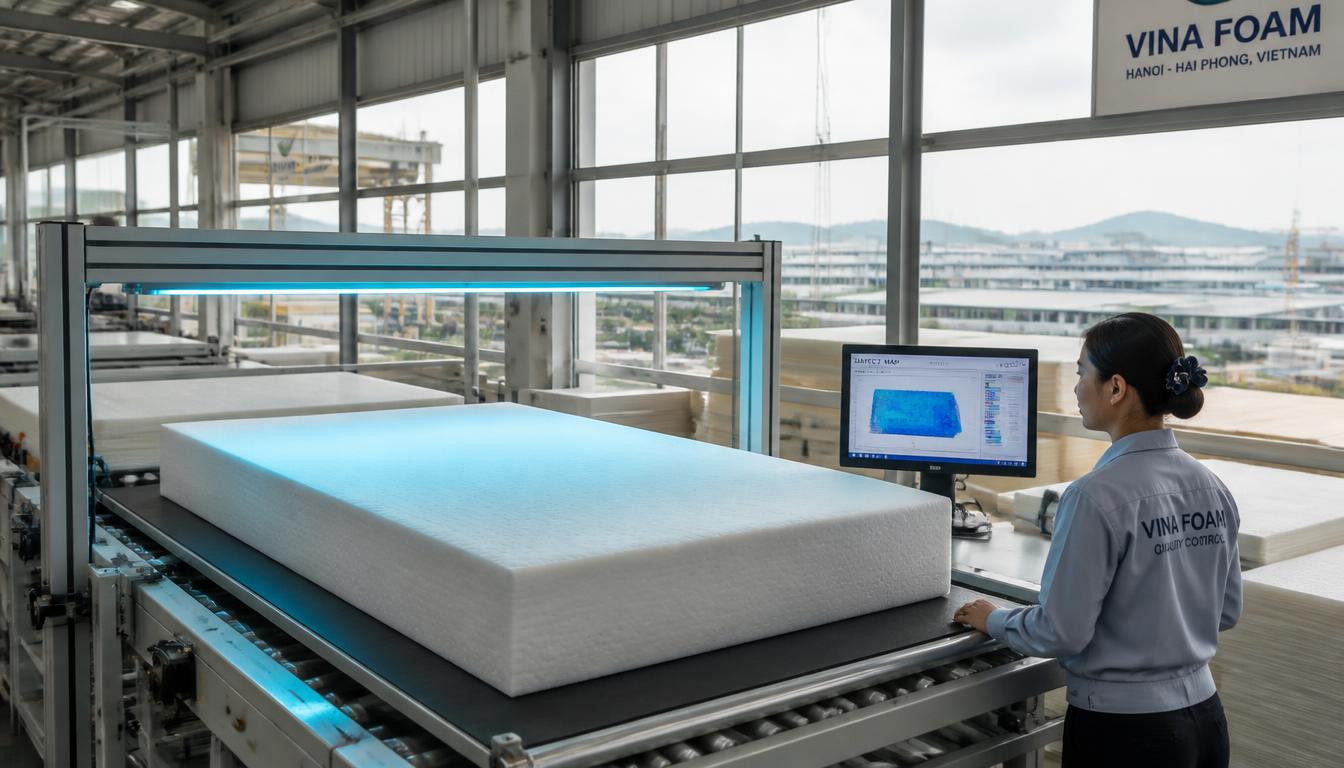
The Inspection Line They Had Been Priced Out Of: AI Quality Control for a Vietnamese Foam Manufacturer
A mid-sized manufacturer of foam cores and mattress components in the Hanoi-Hai Phong industrial corridor of northern Vietnam, supplying both domestic Vietnamese bedding brands and export customers in Western Europe. Like many manufacturers that expanded production in Vietnam as part of a broader China+1 diversification strategy, the company had grown quickly on competitive labour costs and improving logistics infrastructure — but its quality control had not kept pace with that growth. Checking for density consistency, surface defects, seam alignment and material contamination was performed almost entirely by visual inspection from line workers. As volumes grew and the company took on more European clients with stricter defect-rate tolerances and documentation requirements, three problems became increasingly costly: inconsistent defect detection, particularly for the subtle density and compression variances that are difficult for the human eye to catch reliably across a full shift; rising rework and return rates from European buyers, some of whom had begun requesting batch-level quality documentation the company could not easily produce; and a tightening local labour market for trained quality inspectors, with turnover making it difficult to hold a consistent grading standard over time. The company had explored automation but hit a familiar obstacle — quotes from established European and North American machine-vision integrators for a customised inspection line sat well above what the investment case could justify at its scale, with a payback period too long to win board approval.
Automated inspection at a fraction of Western quotes
Read the full case study →You have an industrial or sourcing project? Let's talk.
First conversation is free and non-binding.
Book a call