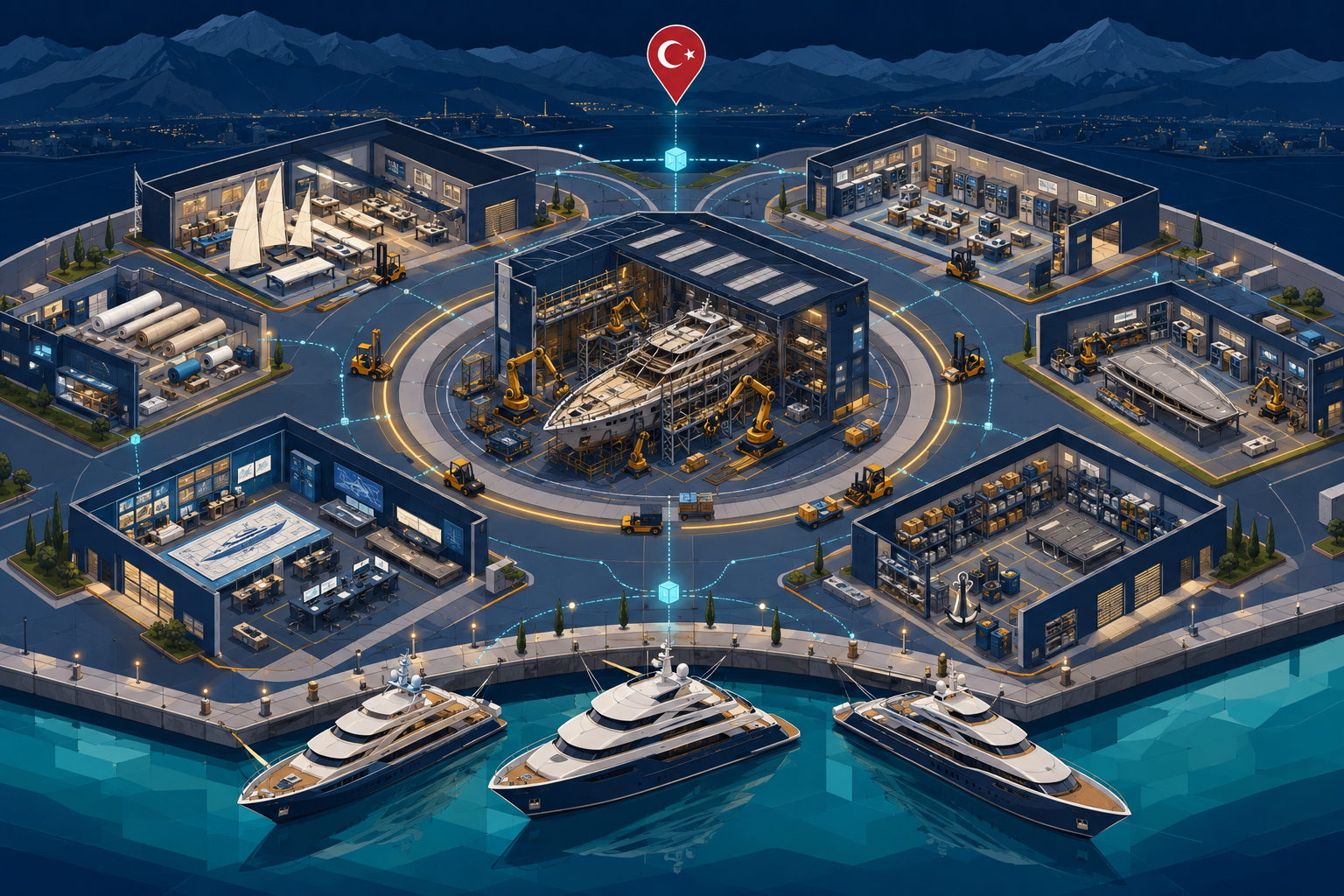
In 2000, the Antalya Free Zone launched three yachts. By 2021 it had produced 500 vessels worth $1.3 billion, and Turkey had risen to second in global luxury yacht production — with 95% of output exported. This is the story of the policy instruments, craft traditions, and cluster logic behind a deliberately engineered industrial ecosystem, and what other industries can learn from it.
In the year 2000, the Antalya Free Zone launched its first yacht. Three vessels entered the water that first year — a modest beginning for what would become one of the world’s most consequential concentrations of luxury boat manufacturing. By 2021, the same zone had produced 500 yachts with a cumulative sales value of approximately $1.3 billion. Turkey had risen to second place in global luxury yacht production. Nearly 95% of everything built in Antalya was exported.
This is not the story of a country discovering a convenient natural resource or benefiting from a historical accident. It is the story of a deliberately engineered industrial ecosystem — a specific combination of policy instruments, geographic advantages, infrastructure investment, and accumulated craftsmanship that took two decades to reach critical mass and that continues to expand. For anyone interested in how industrial clusters form, how they sustain themselves, and what it takes to build credibility in a market defined by quality expectations and long procurement cycles, Antalya’s yacht sector is one of the most instructive case studies of the early twenty-first century.
It is also a story that most European buyers, specifiers, and naval architects only partially understand — they know that Turkey builds yachts, that Turkish-built vessels offer compelling value, and that brands like Bering Yachts and AvA Yachts have established international reputations. What they understand less well is why Antalya specifically became dominant rather than Istanbul or Bodrum, what the free zone structure actually provides that makes the economics work, and what the cluster’s workforce depth and supply chain integration mean for product quality at different price points.
This article explains all of it.
Part I — Before the Free Zone: The Foundation That Made It Possible
Turkey’s maritime culture and the gulet tradition. Turkey did not enter the yacht industry in 2000. It entered a new chapter of an industry it had been developing for half a century. The foundation was the gulet — the traditional wooden sailing vessel of the Turkish Aegean and Mediterranean coast, a two-masted schooner with rounded stern lines that had been used for cargo transport and fishing in the Bodrum and Marmaris regions for generations.
The gulet’s transformation into a luxury charter vessel began in the 1940s and 1950s, associated in particular with the Turkish poet and novelist Cevat Şakir Kabaağaçlı — known as "Halikarnas Balıkçısı" (the Fisherman of Halicarnassus) — whose writings celebrated the experience of sailing the Turkish coast and whose blue voyage concept (mavi yolculuk) created the cultural framework that positioned the gulet as a vessel of leisure and exploration. By the 1970s and 1980s, Bodrum had become Turkey’s gulet capital: a town with dozens of small boatyards, generations of carpenters with deep knowledge of traditional wooden boat construction, and a steady stream of Turkish and European charter clients discovering the Turquoise Coast.
This tradition matters for Antalya because it established something that free zone incentives alone cannot create: a craft knowledge base. Turkish boatbuilders from the Aegean coast region had accumulated two or three generations of woodworking skill — joinery, deck finishing, interior cabinetmaking, hull shaping — that is directly applicable to luxury yacht construction. When the Antalya Free Zone began attracting yacht builders in the late 1990s and early 2000s, it was drawing on a labor market that already understood the precision requirements of high-end marine construction, not simply on a workforce that needed to be trained from scratch.
The structural shift: from gulets to superyachts. The transition from traditional wooden gulets to the fiberglass, aluminium, and steel vessels that define contemporary yacht production was a structural shift that required new technical capabilities alongside the existing craft traditions. This transition happened across Turkey’s boatbuilding sector through the 1990s, driven by several forces simultaneously.
European yacht buyers were increasingly specifying composite or metal hulls — fibreglass for mid-range vessels, aluminium for performance-oriented designs, steel for long-range explorer yachts. The structural advantages of these materials over wood — lower maintenance, greater design freedom, longer operational lifespans — were compelling, and Turkish yards that wanted to access the growing international luxury market needed to develop the relevant skills. The knowledge transfer came partly from European naval architects and project managers who began working with Turkish yards on commission builds, partly from Turkish engineers who trained in Europe and returned, and partly from the industrial logic of learning by doing in a competitive environment.
By the time the Antalya Free Zone began its yacht-focused development, Turkey had a maritime sector capable of working across multiple construction technologies. The gulet tradition had not disappeared — it had been joined by composite and metal construction expertise that made Turkish yards capable of addressing the full specification range of the international luxury market.
Part II — The Free Zone Structure: What It Actually Provides
The policy architecture. The Antalya Free Zone (Antalya Serbest Bölge) is one of a network of free zones established by the Turkish government to attract export-oriented investment by offering a specific package of regulatory and fiscal incentives. The zone’s advantages for yacht manufacturers include, in combination: exemption from customs duties on imported materials and equipment, corporate tax exemptions for companies generating revenues from export sales, exemption from value added tax on goods and services within the zone, and — critically — a labour environment where wage scales and employment conditions differ from the general Turkish market.
For a yacht builder, these incentives interact in ways that are structurally important for the economics of the business. A luxury yacht incorporates a wide range of imported components: marine diesel engines from Germany or the United States, electronic navigation and communication systems from specialist manufacturers across Europe and North America, hydraulic systems, generator sets, watermakers, deck hardware, rigging, sails, and interior fitments including high-specification kitchen equipment, bathroom hardware, and AV systems. For a 25-metre yacht, the proportion of total build cost attributable to imported systems and components can easily reach 40-50% of the vessel’s sale price. The absence of customs duties on these inputs — which would otherwise add 10-20% to their landed cost in Turkey — is a material saving that directly affects price competitiveness.
The export-revenue tax advantage is equally significant. A yacht builder in Antalya that sells 95% of its output to foreign buyers is, in normal tax terms, generating almost all of its revenue from export sales — the category that qualifies for the corporate tax exemption. The fiscal advantage this creates relative to a shipyard operating outside the free zone is substantial and structurally ongoing rather than a temporary incentive.
What the free zone does not provide — and why that matters. The free zone structure provides cost advantages. It does not provide quality. This distinction is commercially important and is sometimes confused in discussions of Turkish yacht production that attribute the sector’s success primarily to price competition.
A free zone exemption does not improve the quality of a welding bead, the finish of a teak deck, or the integration of an electronic systems installation. These depend on the skill and motivation of the workforce, the quality management systems of the individual shipyard, the standards imposed by the international classification societies and flag state authorities whose surveys the vessel must pass, and — in the case of vessels built to buyer specification — the scrutiny of the owner’s representative or naval architect present at key build stages.
What the free zone does is ensure that Antalya-based yards can price competitively enough to attract the international orders that generate the learning, the reputation, and the workforce development that build genuine quality capability over time. The financial incentive is the enabler; the capability development is the actual product of the ecosystem.
Part III — The Cluster Logic: Why Antalya and Not Bodrum or Istanbul
The economics of co-location. Industrial clusters deliver competitive advantages that are not available to isolated manufacturers, no matter how capable. In the context of yacht building, the Antalya Free Zone cluster generates four specific advantages that individual yards outside the cluster cannot replicate.
The first is supplier proximity. As the cluster grew, specialist marine subcontractors established operations in or near the zone: metalwork fabricators, joinery workshops, upholstery specialists, electrical installation contractors, marine painting and antifouling applicators, and equipment installation specialists. A shipyard building a 30-metre aluminium vessel needs hundreds of subcontracted work packages to complete the build; when those subcontractors are ten minutes away rather than distributed across multiple provinces or countries, the coordination overhead is lower, the ability to iterate and correct is faster, and the build schedule is more controllable.
The second advantage is workforce density. When 2,500 skilled workers are employed in a single geographic cluster, the labour market efficiency for specialised marine trades — hull welders, composite laminators, marine joiners, systems integration engineers — is fundamentally different from what is available in a dispersed production environment. Yards can hire as orders grow; experienced workers move between employers within the zone, diffusing skills and raising the general competence level of the workforce; and the local education and vocational training ecosystem orients itself toward the skills the cluster needs.
The third advantage is equipment and infrastructure sharing. The zone’s 2,000-ton ship lift — one of the largest haul-out facilities on the Mediterranean coast — serves multiple yards within the zone and represents a capital investment that no single shipyard could justify independently. The same applies to the 560-ton crane capacity, the dry dock facilities, and the port infrastructure that allows sea trials and delivery from the zone. This shared infrastructure enables yards of different sizes to access capabilities that would otherwise require scale they do not individually possess.
The fourth advantage is what economists call knowledge spillovers — the informal diffusion of technical knowledge and commercial intelligence that happens when people with shared professional expertise work in geographic proximity. In a cluster of 48 yacht companies, the conversations that happen between project managers, the informal benchmarking of build techniques, the awareness of what works and what does not in specific design configurations — these informal channels of knowledge transfer accelerate the general capability development of the cluster in ways that no formal training programme can replicate.
Why Antalya specifically. The choice of Antalya as the anchor location for Turkey’s premium yacht cluster, rather than the established nautical centres of Bodrum, Marmaris, or Istanbul, reflects a combination of geographic, climatic, and policy factors that were not all obvious at the outset.
Geographically, Antalya offers sheltered deepwater access on the Mediterranean coast, a large modern port infrastructure that was already handling significant cargo volumes, and good overland connections to Istanbul and the major Turkish industrial cities. The Mediterranean climate — reliably dry and warm for more months per year than the Aegean coast — extends the effective outdoor working season for hull construction and deck fitting, reducing the schedule disruption that weather causes in northern European shipbuilding locations.
The decision to site a free zone in Antalya, and the subsequent government support for developing its yacht sector specifically, reflected a conscious economic development strategy for the Antalya region, which was already Turkey’s leading tourism destination but sought to diversify its economic base beyond hospitality and retail. Yacht manufacturing fitted this strategy because it offered high value-added employment, a strong export orientation, and an association with the luxury segment of the tourism and maritime leisure economy that reinforced the region’s premium positioning.
The self-reinforcing dynamics of cluster development did the rest. Once the first international yards established in Antalya, others followed because Antalya was where the infrastructure, the workforce, and the subcontractor network were developing. The concentration became self-sustaining.
Part IV — The Companies: Who Built the Cluster
Damen Shipyards Antalya: the credibility anchor. The presence of Damen Shipyards in Antalya is commercially and symbolically significant in ways that go beyond the Dutch group’s individual output. Damen — one of the world’s largest shipbuilding groups, with production facilities across the Netherlands, Romania, South Africa, Vietnam, and other locations — brings to Antalya a level of industrial credibility that signals to international buyers, classification societies, and equipment suppliers that the zone is a serious, professionally managed shipbuilding environment rather than an opportunistic low-cost production site.
Damen’s technology transfer to its Antalya operation — the production management systems, quality documentation processes, construction methodologies, and supplier qualification standards that the group applies globally — has had spillover effects on the broader cluster. Workforce that has worked through Damen’s production systems carries those standards and expectations to other yards. Equipment suppliers who have been qualified to Damen’s procurement requirements have raised their own capability in response.
Sarp Yachts: the custom build specialist. Sarp Yachts represents the evolution of Turkish yacht construction toward fully custom, large-format builds. The company’s 10,000 square metre facility in the Antalya Free Zone positions it among the largest dedicated yacht construction facilities in the Mediterranean, capable of handling vessels well above 30 metres to the standards that international buyers and their naval architects impose on custom builds. Sarp’s presence in the zone illustrates the progressive scaling of ambition that characterises mature cluster development: early-stage clusters attract volume producers; mature clusters attract builders capable of the technically complex, closely supervised custom builds that command the highest margins and the most demanding quality standards.
AvA Yachts: the explorer segment. AvA Yachts occupies a specific position in the premium segment — the explorer yacht category, which represents one of the most technically demanding and fastest-growing niches in the international luxury yacht market. Explorer yachts are built for range and seakeeping rather than pure speed or interior extravagance: heavy displacement steel or aluminium hulls, large fuel and water capacity, long-range diesel or diesel-electric propulsion, and a design philosophy that prioritises the ability to access remote destinations over the cosmetic priorities of charter-focused designs. The fact that Antalya hosts a credible explorer yacht builder is significant because the category requires capabilities — structural steel welding to classification society standards, systems integration for long-range voyaging equipment, naval architectural sophistication in stability and seakeeping analysis — that are distinct from general yacht building competence and represent a higher level of technical maturity.
Dynamiq: refit and conversion. Dynamiq’s decision to establish refit and conversion operations in Antalya represents the business model diversification that marks the third stage of cluster maturity. The first stage is new-build volume; the second is premium new-build quality; the third is the full-service ecosystem that captures aftermarket revenue alongside production income. Refit and conversion work has specific commercial advantages. It stabilises yard workloads during periods when new-build order intake softens — as it did significantly during the disruptions of 2020-2022. It builds long-term relationships with vessel owners who may return for subsequent builds or recommend the yard to their networks. And it requires a different but complementary set of skills to new construction — the ability to assess existing vessel structures, integrate new systems with legacy installations, and manage the project complexity that arises when you are modifying something that already exists rather than building from a clean sheet. For Antalya as a cluster, Dynamiq’s refit operations represent a broadening of the service offer that makes the zone more valuable to the international yacht market — not just a place to commission a build but a place to return to throughout a vessel’s operational life.
Bering Yachts: the global production network. Bering Yachts is perhaps the most instructive case study in the Antalya cluster for what it reveals about how the zone functions in an internationally networked production model. The company operates a major shipyard in Antalya employing over 200 craftsmen across approximately 5,000 square metres of facilities — significant scale for a yacht builder, and growing. Bering specialises in semi-custom steel and aluminium explorer yachts — the same category that AvA Yachts pursues — with a range extending from 55 to 145 feet and an operational philosophy explicitly oriented toward long-range capability. The company is not a Turkish firm in the conventional sense: it is better understood as an internationally networked production operation that has chosen Antalya as its primary manufacturing base because Antalya offers the combination of technical capability, infrastructure, and cost structure that makes the business model work.
Recent reporting on Bering’s Antalya operation describes significant growth in order intake and facility expansion — a trajectory that reflects both the broader strength of the explorer yacht category in international demand and the specific appeal of Antalya as a build location for internationally marketed vessels. The company’s expansion also demonstrates the self-reinforcing character of cluster development: as Bering invests in facilities and workforce in Antalya, it adds to the cluster’s overall capability and attractiveness for subsequent investors. The Bering model — internationally marketed, Antalya-produced, globally distributed after-sales network — is the template for how the Antalya cluster functions at its most sophisticated: not a local industry producing for a local market, but a globally competitive production base plugged into international marketing and distribution systems.
Part V — The Workforce: Craftsmanship as Competitive Advantage
The skill spectrum. Yacht manufacturing at the quality level that commands international luxury prices requires a workforce that spans a wide range of trade skills and integrates them under a coordinated production management system. The Antalya cluster’s 2,500 direct yacht sector employees represent a concentration of skills that includes hull construction specialists — welders qualified to marine classification society standards (Bureau Veritas, Lloyd’s Register, DNV) in aluminium and steel, whose work is the structural foundation of the vessel and must meet exacting penetration, distortion control, and non-destructive testing criteria.
Composite technicians — laminators and vacuum infusion specialists capable of producing fibreglass and carbon fibre structures to the dimensional accuracy and strength requirements of high-performance yacht hulls. Marine joiners — the interior cabinetmakers, teak deck installers, and finish carpenters whose visible work defines the perceived quality of the vessel in the owner’s experience. This is where Turkish craft tradition is most directly and commercially relevant: the joinery skills that were developed in gulet workshops over decades translate directly into the furniture-grade interior work that luxury yacht buyers expect.
Systems integration engineers — the electricians, plumbing engineers, and electronics specialists who install and commission the navigation, communication, propulsion control, house power, and climate systems that a modern luxury yacht incorporates. At the 30-metre-plus level, the systems complexity of a yacht rivals that of a small commercial vessel, and the integration challenge — making hundreds of systems from dozens of suppliers work reliably together — requires genuine engineering capability. Project managers — the production supervisors, quality controllers, and owner liaison specialists who manage the build process, communicate with clients and their representatives, and ensure that specification compliance and schedule are maintained. The internationalisation of the Antalya cluster has required a parallel development of project management capability in English and other European languages, and this management layer is now one of the cluster’s strengths.
The cost-quality position. Turkish labour costs — even after the wage increases that Turkey’s inflation environment has produced over the past five years — remain substantially below those of the established Western European yacht building centres. A skilled welder in Antalya earns a small fraction of the equivalent rate in the Netherlands or Germany; a marine joiner’s day rate in Turkey compares favourably against the rates charged by the same category of tradesperson in the Italian Versilia coast yards or the UK south coast shipyards.
This cost position is not, at this stage of the cluster’s development, primarily about competing on price. It is about enabling Turkish yards to offer quality-competitive products at price points that are accessible to a broader range of buyers than the traditional European centres can serve. A vessel that would cost €4 million to build in Germany or the Netherlands at equivalent quality specification may be achievable in Antalya at €2.8-3.2 million. The quality gap — which existed in the early 2000s and was real — has narrowed to the point where it is no longer a primary factor for well-supervised builds, and the price gap has narrowed less than the quality gap.
The ongoing challenge for Antalya’s yards is managing the interaction between Turkish lira volatility and their cost structures. The dramatic depreciation of the lira in the 2018 and 2021-2022 episodes — which reduced the real cost of Turkish labour in euro and dollar terms very significantly — was commercially advantageous for yards pricing in hard currencies while paying local wages, but it also increased the cost of the imported components that constitute a large share of a luxury yacht’s total bill of materials. Managing this exposure has required financial sophistication that is now standard practice among the cluster’s established yards.
Part VI — The Certification Framework: How International Standards Underpin Commercial Credibility
Classification societies and their role. A luxury yacht built for international sale must carry certification from a recognised maritime classification society — Bureau Veritas, Lloyd’s Register, DNV (Det Norske Veritas), RINA (Registro Italiano Navale), or their equivalents. Classification society certification is not a commercial add-on; for vessels operating in commercial charter, it is legally required. For privately owned vessels, it is the primary quality assurance mechanism that buyers and their insurers rely on.
Classification involves continuous survey during construction — inspectors from the relevant society are present at key structural stages, witness weld testing, review structural calculations, and verify that the vessel as built conforms to the approved drawings. A vessel that carries a classification society certificate has passed a rigorous external quality check at every significant construction stage, not merely a final inspection.
The Antalya cluster’s engagement with classification society survey is one of the most important indicators of its maturity. Yards that build to classification standards must maintain documented quality management systems, calibrate their inspection equipment, qualify their welders to class standards, and submit to unannounced inspector visits. The discipline this imposes on production processes is significant, and the presence of class-trained personnel in Antalya — surveyors from Bureau Veritas and DNV are based in or regularly visiting the zone — reflects the maturity of the cluster’s engagement with international standards.
The CE marking framework for recreational craft. For the European market — which is the primary destination for Antalya-built yachts — the EU Recreational Craft Directive (and its successor, the Recreational Craft Regulation) requires that vessels up to 24 metres placed on the European market carry CE marking, demonstrating conformity with the Directive’s stability, buoyancy, construction, and equipment requirements.
CE marking under the Recreational Craft Directive requires either self-certification against harmonised European standards or assessment by a Notified Body — an approved European organisation qualified to conduct third-party conformity assessment. Turkish yards exporting to European buyers routinely engage European Notified Bodies, and the documentation requirements for Recreational Craft Directive conformity have become a standard part of the Antalya cluster’s production process.
The combination of classification society certification (for larger or commercial vessels) and Recreational Craft Directive CE marking (for the recreational fleet) means that Antalya-built yachts entering European waters carry a regulatory compliance documentation package that is, in principle, equivalent to vessels built anywhere in Europe. The practical quality verification that this documentation implies is one of the factors that has enabled the cluster’s commercial acceptance in the most demanding European markets.
Part VII — The Market: Who Buys Antalya-Built Yachts
The geographic distribution of buyers. The 95% export rate that characterises Antalya’s production tells a story of almost complete orientation toward international demand. The domestic Turkish market for luxury yachts exists but is small; the cluster’s growth has been driven by European, North American, and Middle Eastern buyers who discovered Turkey as a build location through broker networks, naval architect recommendations, and the growing visibility of Turkish-built vessels at international boat shows.
European buyers — primarily from Germany, the Netherlands, Scandinavia, the United Kingdom, France, and Italy — have historically been the largest segment of Antalya’s customer base. These buyers bring demanding quality expectations and detailed specification requirements; the experience of building for European principals has been one of the primary drivers of the cluster’s quality development, because European buyers and their representatives inspect closely and specify precisely.
North American buyers — from the US and Canadian markets — have become an increasingly significant segment, particularly in the explorer yacht category where Bering and AvA Yachts’ ranges are specifically positioned. The long-range capability of steel and aluminium vessels built in Antalya aligns well with North American buyers’ interest in vessels capable of offshore passage-making and access to remote destinations.
Gulf region buyers — from the UAE, Saudi Arabia, Kuwait, and Qatar — represent a market with specific preferences for size, interior specification, and operational capability. The Gulf market’s appetite for large, highly specified vessels is a natural fit for the larger Turkish yards, and the combination of geographic proximity (the Red Sea and Gulf are reachable from the Mediterranean in reasonable passage times) and the UAE’s established role as a yacht services hub creates a commercial ecosystem that supports this segment.
Russian buyers — historically a significant market for Turkish-built yachts due to geographic proximity, established trading relationships, and a shared understanding of the value of Turkish craftsmanship — have faced significant disruption since the sanctions environment that followed the 2022 events. This has been a headwind for the cluster that individual yards have managed differently depending on their exposure to this buyer segment.
The broker and naval architect network. Yacht purchases above 20 metres almost universally involve professional intermediaries: yacht brokers who represent buyers and sellers, and naval architects or project managers who oversee the technical specification, tender, and build supervision process on behalf of the buyer. The Antalya cluster’s commercial success depends significantly on the attitude of this professional intermediary layer toward Turkish-built vessels.
The evolution of broker and naval architect opinion regarding Turkish production quality has tracked the cluster’s actual quality development. In the early 2000s, scepticism about Turkish yards was common in professional circles — the cluster was young, the quality evidence was limited, and the established European centres had the benefit of long reputations. By the 2010s, as Antalya yards accumulated records of successful builds to the specifications and survey requirements of demanding European buyers, the professional intermediary community’s assessment had shifted significantly.
Today, Turkey — and specifically Antalya — is firmly on the shortlist for custom build briefs in the 20-50 metre range for buyers seeking value without compromise on specification. The naval architects and project managers who have supervised Antalya builds and delivered positive outcomes have become advocates within their professional networks; the cluster’s reputation has propagated through the recommendation systems that drive purchase decisions in a market where individual transactions are high-value and infrequent.
Part VIII — The Evolution: From New Build to Full Lifecycle Services
The refit and maintenance opportunity. The maturation of any yacht-building cluster eventually leads to the development of refit, maintenance, and conversion services that capture revenue across the vessel’s operational lifespan rather than only at the point of initial construction. Antalya has followed this trajectory deliberately.
The cluster’s infrastructure — the 2,000-ton ship lift, the dry dock facilities, the subcontractor network for systems and structural work — is as well-suited to refit work as to new construction, and the economics of refit work have specific advantages: lower capital intensity, shorter project cycles, more predictable revenue streams from clients who return regularly, and a diversification of the revenue base away from the order-intake volatility that characterises new-build shipbuilding.
Dynamiq’s establishment of refit and conversion operations in Antalya is the most prominent example of this diversification, but it reflects a broader pattern in the cluster where yards of all sizes have added refit capability alongside their new-build lines. The result is a cluster that now offers a credible full-lifecycle service proposition — build your vessel in Antalya, maintain it in Antalya, refit it in Antalya — that creates long-term commercial relationships with vessel owners rather than transactional, build-and-done interactions.
The digitisation and systems complexity challenge. Contemporary luxury yacht construction is increasingly defined by the complexity and integration of onboard systems rather than primarily by structural and finishing craftsmanship. The navigation electronics package on a 35-metre contemporary vessel is more sophisticated than that of a commercial coastal freighter built twenty years ago; the power management systems, network infrastructure, and smart ship controls that owners now expect require design capability and installation expertise that is genuinely different from traditional shipbuilding trades.
For Antalya’s cluster, the evolution toward higher systems complexity is both an opportunity and a challenge. It is an opportunity because sophisticated systems integration commands higher margins and differentiates capable yards from those competing on structural and finishing craft alone. It is a challenge because it requires sustained investment in engineering education, software competence, and the supplier relationships with systems manufacturers that provide the training and support that yards need to install and commission complex integrated systems.
The cluster’s response — investment in engineering education, partnership programmes with Turkish technical universities in Antalya and across the country, and the establishment of specialist systems integration contractors within the zone — reflects a recognition that the skills required for the next generation of luxury yacht production are different from those that built the cluster’s initial reputation.
Part IX — Lessons from the Antalya Model: What Other Industries Can Learn
The conditions for cluster success. Antalya’s yacht ecosystem did not emerge from a single policy decision or a single investor’s choice. It emerged from the combination of several conditions that, taken together, created the environment for self-sustaining cluster development.
The free zone policy provided the fiscal and regulatory foundation — the cost structure that made Antalya competitive enough to attract the initial investments before the cluster’s quality reputation was established. Without the free zone, the initial competitiveness advantage that brought the first international yards to Antalya would not have existed, and the cluster would never have reached the scale at which it became self-reinforcing.
The pre-existing craft tradition provided the human capital foundation — the generations of maritime craftsmen whose skills were applicable to modern yacht construction, reducing the workforce development investment required and accelerating the quality trajectory of the cluster’s earliest builds. Clusters built on genuine craft traditions develop quality faster than those built on cost advantage alone.
The infrastructure investment — the ship lift, the crane capacity, the port facilities — provided the physical capacity foundation without which the quality ambition of the cluster’s individual yards would have been constrained by the inability to handle larger or more complex vessels. Infrastructure investment at the cluster level enables individual yard development that would not otherwise be possible.
The international engagement — the attraction of established players like Damen, the development of buyer relationships with demanding European principals, the involvement of classification societies and Notified Bodies in routine production practice — provided the quality benchmark that drove the cluster’s development. Clusters that benchmark against local standards stagnate; clusters that engage with the most demanding international standards develop at the pace of their most capable members.
The twenty-year trajectory. The most important single observation about the Antalya cluster’s development is its timeframe. From three yachts in 2000 to $1.3 billion in cumulative sales by 2021 is a twenty-year journey. The policy infrastructure was established before it was certain that the cluster would succeed; the workforce development preceded the order book that would eventually justify it; the infrastructure investment was made before the vessel sizes that would use it were being commonly built.
Building a world-class industrial cluster requires the willingness to invest ahead of proven demand — to create the conditions for success before success is visible. This is the decision-making discipline that European industrial policy has most consistently struggled to maintain and that Turkey, in Antalya’s case, managed with unusual effectiveness.
Conclusion: Antalya’s Continuing Trajectory
By 2026, the Antalya Free Zone yacht cluster is a mature industrial ecosystem with genuine global competitive credentials. The three vessels of 2000 have become a continuous flow of builds across a range from 10 to 90 metres, built to international classification standards, sold to buyers in Europe, North America, the Gulf, and beyond. Turkey’s position as second in global luxury yacht production is not an accident of geography or currency — it is the product of deliberate policy, accumulated craftsmanship, and the compound returns of two decades of cluster development.
The cluster faces real challenges going forward: the management of materials cost inflation and currency volatility; the skills development investment required to keep pace with increasing systems complexity in premium yacht specifications; the competitive pressure from other emerging maritime production locations in Southeast Asia and Eastern Europe; and the geopolitical disruptions that have affected specific buyer markets.
None of these challenges appear sufficient to reverse the trajectory of a cluster that has built genuine technical capability, international commercial relationships, and a self-sustaining industrial ecosystem. The yards that built the cluster’s reputation — Damen, Sarp, AvA Yachts, Dynamiq, Bering — continue to expand their facilities and order books. The workforce that gives the cluster its quality foundation continues to grow and develop.
For European buyers and specifiers evaluating Antalya as a build location, the question is no longer whether the quality is adequate. It is whether the specific yard, build supervision approach, and commercial structure of a given project are suited to capturing the quality capability that the cluster demonstrably possesses. The ecosystem is there. Using it well is the professional task.
Tags
Sources
Daily Sabah — Antalya yacht zone production and export data; Marine Industry News — Dynamiq refit operations in Turkey; Hurriyet Daily News — Turkey’s rise to second in global luxury yacht production (2022); YachtBuyer — Antalya revenue reaches $1.2 billion landmark; Boat International — Sarp Yachts profile; AvA Yachts — Company and shipyard documentation (avayachts.com); Damen Shipyards Antalya (damen.com); Bering Yachts — Antalya shipyard expansion reports (beringyachts.com); Boote Magazin — Bering Yachts Antalya shipyard report; Superyacht Investor — Turkish luxury yacht market developments; AYSAD (Association of Turkish Yacht Builders) — sector statistics; MAXAM Group — maritime sector sourcing and supplier qualification programme.