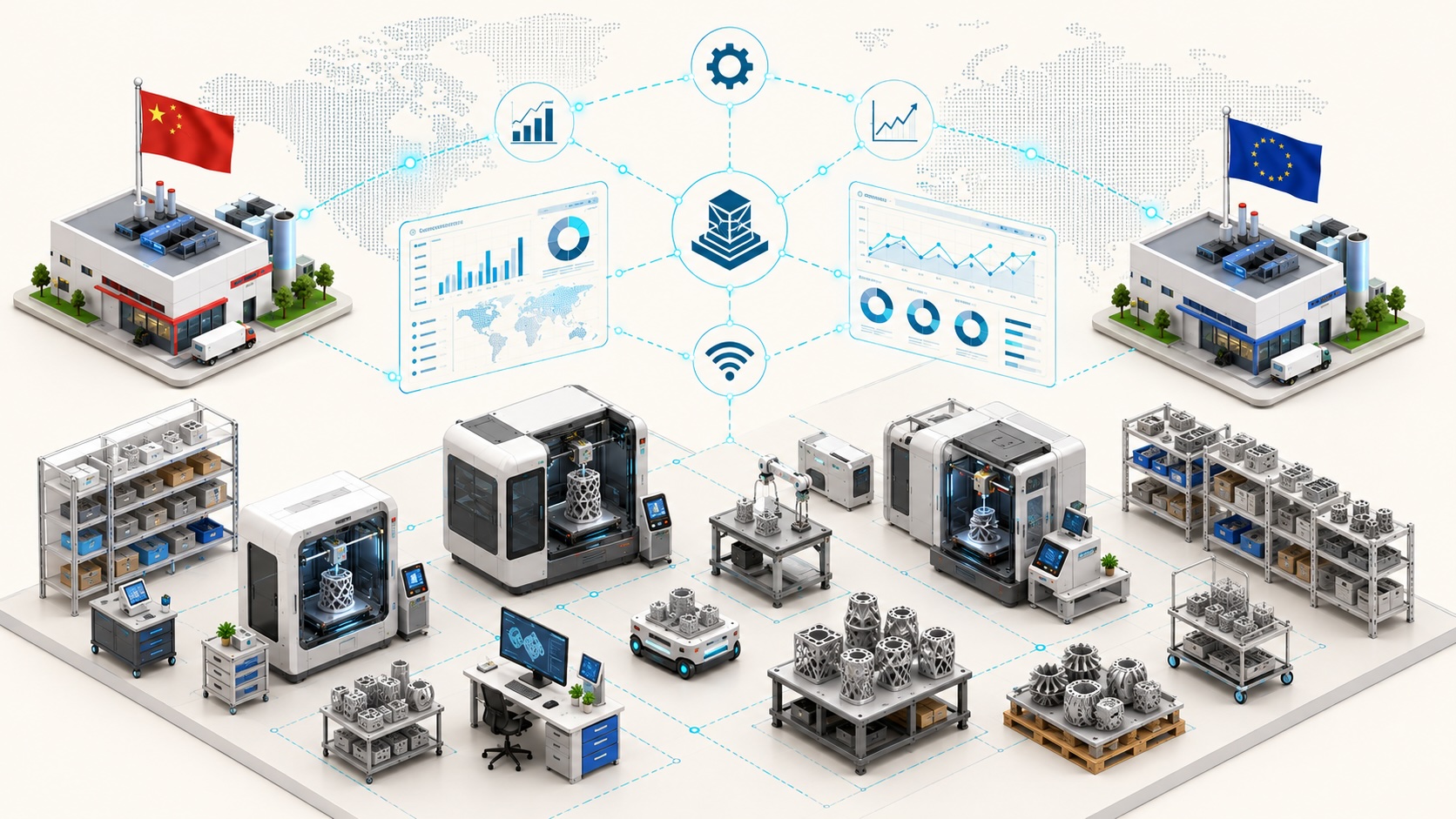
Chinese manufacturers shipped more than 90% of the world’s entry-level 3D printers in 2025, and four Shenzhen companies alone account for roughly nine in ten consumer units — while Beijing’s draft 15th Five-Year Plan targets RMB 150 billion in industrial additive manufacturing by 2030. Meanwhile European SMEs are moving 3D printing out of the R&D lab and onto the production floor. We map where those two curves meet, and where the diligence work actually sits.
European small and medium manufacturers are rethinking what 3D printing is for. Long treated as a prototyping tool confined to R&D departments, additive manufacturing (AM) is becoming a production-grade capability that SMEs use to build resilience against energy costs, supply chain shocks, and tightening EU sustainability rules. At the same time, China is not just adopting this shift — it is manufacturing most of the hardware behind it. For European SMEs, and for the consultants who advise them, understanding both sides of that equation is now a sourcing question, not just a technology question.
Why European SMEs Are Moving From Prototyping to Production
Three pressures are pushing this shift simultaneously.
Energy costs and supply chain fragility have made SMEs wary of holding large physical inventories or depending on long, multi-country logistics chains for spare parts and tooling. A part that can be printed on demand does not need to be warehoused, insured, or shipped from a distant supplier on a fixed lead time.
EU sustainability mandates are pushing companies toward processes with lower material waste and a smaller carbon footprint than subtractive methods like CNC machining or injection moulding. As reporting obligations under frameworks such as the CSRD extend further down the supply chain, the material-efficiency case for additive processes becomes a compliance argument as much as a cost argument.
Labour economics favour a technology that reduces the need for large tooling investments and specialised machinists for every new part design — relevant in a European manufacturing environment already short of skilled machine operators.
In practice, this shows up on the shop floor in two distinct ways. The first is the rise of “microfactories”: instead of warehousing spare parts, SMEs store digital 3D models and print components on demand, cutting both inventory cost and delivery lead time simultaneously. The second is a shift from prototyping into rapid tooling — printing jigs, fixtures, and custom moulds in-house in hours rather than ordering them from an external toolmaker over weeks.
Because the capital cost of certified, production-grade systems — especially metal AM — remains high, many SMEs are approaching this transition through EU-funded collaborative networks rather than going it alone. The 3DoP (3D Printing optimised Production) project is a concrete example: an EU-backed consortium that gives SMEs free trials of technical and non-technical services, from metal 3D printing capacity to funding and business-case coaching, specifically to help them cross the gap between lab-tested technology and commercial deployment.
China’s Position: Manufacturing the Hardware Behind the Shift
This is the part of the story that matters most for a sourcing consultancy, and it runs in parallel to a pattern already visible in industrial robotics: China has become the dominant global manufacturer of 3D printing hardware, at both the consumer and industrial level.
Consumer and Desktop-Grade Hardware: A Near-Monopoly
Market intelligence firm CONTEXT reported that Chinese manufacturers accounted for more than 90% of global entry-level 3D printer shipments in 2025, climbing to as much as 95% in some quarters — a concentration one analyst compared to Japan’s dominance of consumer electronics in the 1980s. Four Shenzhen-based companies — Bambu Lab, Creality, Anycubic, and Elegoo — account for roughly nine in ten consumer 3D printer shipments worldwide, and about 70% of their combined output ends up in Europe and North America. Creality listed on the Hong Kong Stock Exchange in May 2026, becoming the first listed pure-play consumer 3D printer maker — a sign this segment has matured into a serious capital-markets story rather than a cottage industry.
Chinese state media reported that the country exported approximately 2.46 million 3D printers in the first four months of 2026 alone, with export volumes reportedly up sharply year-on-year; industry sources also describe a further surge in exports in the first quarter of 2026. These figures come from Chinese state-affiliated outlets and industry trackers rather than independent audited data, so the exact percentages should be treated as directional rather than definitive.
Industrial and Metal AM: A Deliberate State-Backed Push
China’s approach to industrial-grade and metal additive manufacturing is following the same script already seen in its robotics strategy: sector-specific targets, domestic component self-sufficiency, and export support. Industry research citing China’s Ministry of Industry and Information Technology (MIIT) indicates that the sector grew from roughly RMB 20.8 billion in 2020 to about RMB 70 billion in 2025, and that the draft 15th Five-Year Plan sets a target of RMB 147.9–150 billion in industry scale by 2030, alongside a goal of full domestic self-sufficiency in core components — lasers, galvanometers, optical systems — and an export share exceeding 25% of the global total. A joint action plan from six Chinese ministries reportedly includes measures such as VAT refund increases and export credit insurance priority for metal and industrial-grade 3D printers — the same kind of institutional alignment seen behind the robotics sector’s five-year plan.
These industry-scale and policy figures come from Chinese industry research reports and should be treated as indicative of direction and ambition rather than confirmed hard numbers. They are worth cross-checking against MIIT’s own publications before quoting them in a client-facing deliverable.
Platform Lock-In Is Part of the Export Model
It is worth flagging a nuance for a European buyer: leading Chinese consumer and desktop brands increasingly ship printers bundled with proprietary software, cloud connectivity, and access to a branded design library — turning what looks like a simple hardware purchase into a closed-loop system built around a Chinese-designed platform. This matters for procurement decisions: the printer itself is often the entry point, not the full product being sold.
What This Convergence Means for European SMEs
Put together, the European demand story and the Chinese supply story line up closely — and this is where a sourcing consultancy’s diligence work becomes directly relevant.
Chinese hardware already dominates the price-accessible end of the market SMEs actually buy from. For an SME testing whether AM can replace a specific tooling or spare-parts workflow, the desktop and mid-tier machines it is most likely to evaluate are, in the large majority of cases, already Chinese-made — whether the SME sources them directly or through a European reseller.
Metal and industrial-grade AM is where the real opportunity, and the real diligence, sits. As metal printing costs fall and Chinese suppliers scale toward the stated 2030 self-sufficiency and export targets, European SMEs in aerospace, automotive, and medical fields will increasingly face genuine Chinese alternatives for selective laser melting systems, not just desktop polymer printers. This is a higher-stakes sourcing decision: certification, material traceability, and after-sales support all carry more weight than on a desktop FDM printer.
Compliance remains a European-side responsibility, not something a Chinese supplier’s marketing will resolve. The ongoing alignment of AM equipment with the EU Machinery Regulation, and standardisation efforts for processes like Binder Jetting, are intended to simplify legal certification for SMEs — but that certification burden sits with the buyer, and needs to be verified for each specific machine and application rather than assumed from a supplier’s general claims.
Software and data considerations deserve the same scrutiny as with any connected industrial equipment. Given that leading Chinese consumer and desktop brands bundle proprietary cloud platforms with their hardware, SMEs with data-sovereignty policies or work in sensitive sectors — defence-adjacent, medical devices — should evaluate the software stack as carefully as the hardware specifications.
Skilled labour remains the bottleneck regardless of where the equipment is sourced. Operating multi-laser metal systems or industrial polymer machinery requires expertise in digital design, metallurgy, and post-processing — a shortage that exists independently of supplier nationality, and one that governs the realistic pace of adoption more than hardware availability does.
A Practical Framework for European Buyers
For an SME — or a consultant advising one — evaluating Chinese AM suppliers, a few checkpoints are worth building into any sourcing process.
Segment the decision. Desktop/polymer AM and industrial/metal AM are different sourcing problems with different risk profiles. Treat them separately rather than applying the same diligence checklist to both.
Verify certification per machine, not per brand. CE marking and EU Machinery Regulation compliance need confirmation for the specific model and its intended use, not assumed from a supplier’s general reputation or the certification status of a different product line.
Ask what is proprietary. Understand whether the machine locks the buyer into a specific materials ecosystem or cloud platform, and what that means for long-term cost and flexibility once the initial purchase is made.
Test the after-sales relationship before scaling. Spare parts availability, technical support responsiveness, and firmware update practices are usually the real differentiator once equipment is in daily production use — not the headline price at the point of purchase.
Use EU-backed collaborative programmes where possible. Networks like 3DoP exist precisely to let SMEs test equipment and de-risk adoption decisions with structured support rather than going it alone on a first purchase.
Pilot before you commit fleet-wide. As with any new supplier relationship or manufacturing geography, running a single machine through a defined evaluation period — covering print quality, support responsiveness, and consumables cost — surfaces problems while the exposure is still small.
The Honest Caveats
A balanced assessment needs to include what remains uncertain.
Export and market-share figures are largely self-reported or trade-press estimates. The 2.46 million unit export figure and the consumer market-share percentages above originate with Chinese state-affiliated media and industry trackers rather than independently audited statistics. They are useful for gauging direction and scale, not as precise figures to be quoted without qualification in a client deliverable.
China’s 2030 industrial AM targets are policy ambitions, not achieved outcomes. The RMB 147.9–150 billion target and the 25%-plus export share goal come from a draft five-year plan. Draft targets in Chinese industrial policy are frequently met or exceeded, but the timeline and final figures should be treated as directional until the plan is finalised and its early implementation can be observed.
The compliance and support landscape for industrial-grade Chinese AM suppliers is still maturing. Unlike the consumer segment, where track records are now well established, European buyers evaluating metal or industrial-grade Chinese AM systems are dealing with a supplier landscape that, in many cases, does not yet have the multi-year regional support history that established Japanese, German, or American systems providers can offer.
The Takeaway
The additive manufacturing story is following an arc similar to the one already visible in industrial robotics: a European demand pull driven by cost, sustainability, and supply chain resilience, meeting a Chinese supply push backed by scale, falling component costs, and — in the case of industrial and metal AM — explicit state industrial policy.
For European SMEs, the opportunity to source capable, increasingly sophisticated Chinese AM equipment is real and growing. The value a consultancy adds sits in the diligence layer: helping SMEs tell the difference between a genuinely production-ready Chinese supplier and one whose scale outpaces its European compliance and support readiness.
Tags
Sources
3dprint.com and 3druck.com (China 3D printer export data, May–June 2026); hellochinatech.com (Shenzhen consumer 3D printer market analysis, June 2026); Coherent Market Insights (Made in China policy and AM market structure); Tianxia Gongchang Research industry report citing MIIT data (China AM 15th Five-Year Plan targets, June 2026); European Cluster Collaboration Platform, Brainport Eindhoven, and ProM Facility (3DoP project details). Given the pace of change in both EU industrial policy and Chinese export data, figures should be re-verified against primary sources — MIIT, Eurostat, official 3DoP publications — before use in a published deliverable.