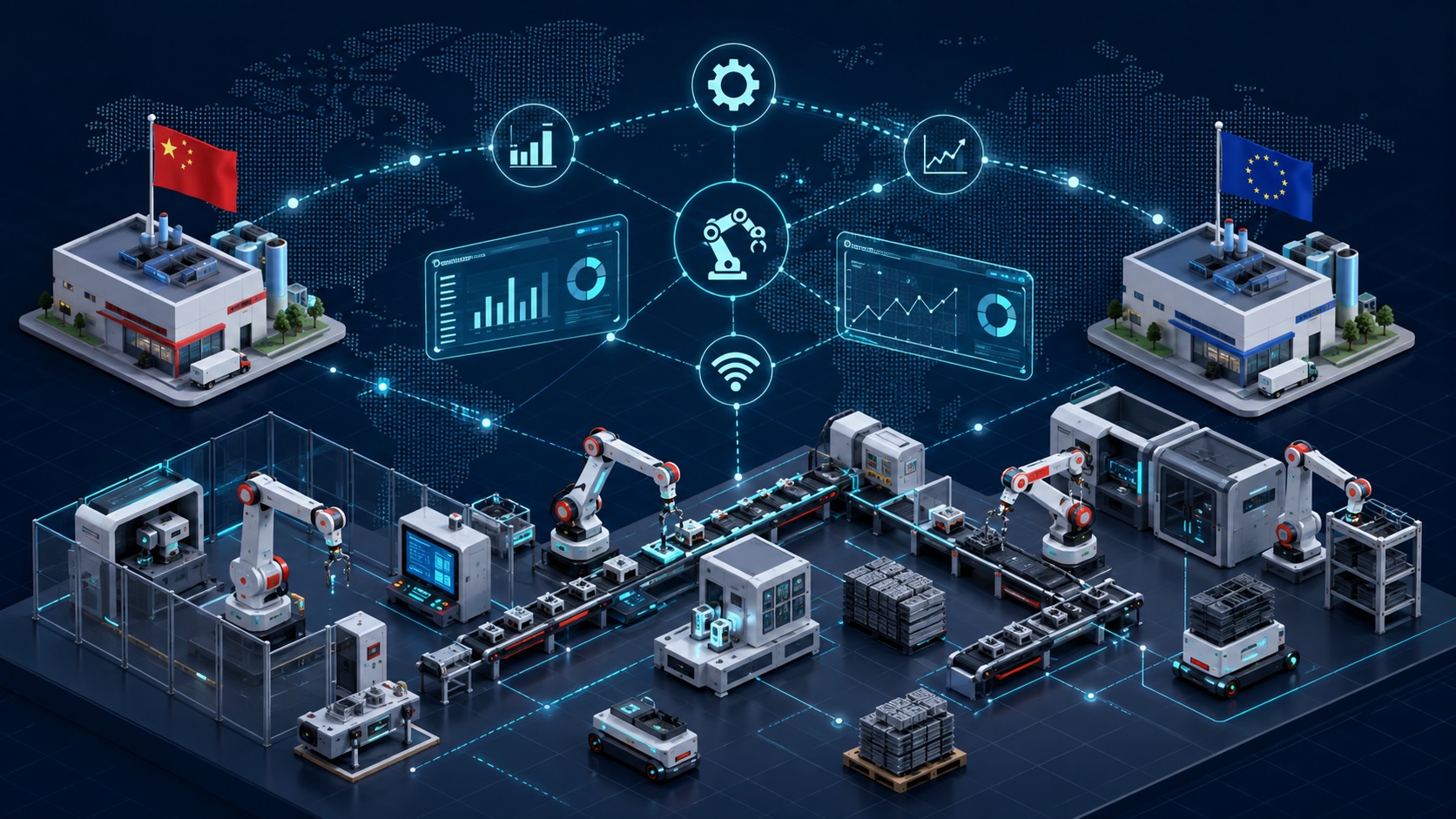
China now operates roughly 2 million industrial robots — about 4.5 times Japan’s installed base — and took delivery of some 54% of all robots installed worldwide in 2025. With the 15th Five-Year Plan placing AI-integrated robotics at the centre of national industrial strategy, and European manufacturing facing a structural shortage of skilled operators, a genuine alignment is forming between Chinese supply-side maturity and European demand. We map the policy, the numbers, the company-level evidence, and what a European buyer must verify before sourcing.
For most European manufacturers, the phrase “made in China” still evokes textiles, electronics assembly, or commodity components. That picture is now out of date in at least one strategically important category: industrial robotics.
A Lead Built Over Two Decades, Not Overnight
China’s position did not appear suddenly. It is the outcome of roughly two decades of deliberate industrial policy layered on top of the country’s existing manufacturing base. Through the 2000s, China built its role as the world’s factory on low-cost labour, scale, and an increasingly dense supplier ecosystem. As labour costs rose through the 2010s and demographic pressure began to build — an ageing population, a shrinking working-age cohort — the country faced a structural problem: how to keep manufacturing competitive without cheap labour.
The answer, formalised in the “Made in China 2025” plan from 2015 onward, was automation. Robotics was named one of ten priority sectors, with an explicit goal of reducing dependence on foreign robot suppliers — Japanese, German, Swiss — and building a domestic supply chain for the components that make a robot work: reducers, servo motors, controllers. For years, Chinese robot assemblers depended on Japanese and European core components. That dependency has eroded steadily. Between 2018 and 2025, China moved from being the world’s largest buyer of industrial robots to also becoming a major producer, with domestic brands increasingly competing directly with established players like Fanuc, ABB, KUKA, and Yaskawa — first on price, and increasingly on quality and software.
The institutional capstone arrived in 2026. In May of this year, the International Federation of Robotics (IFR) reported that China’s new 15th Five-Year Plan (2026–2030) places robotics at the centre of the country’s industrial and AI strategy, shifting emphasis from traditional automation toward AI-integrated, “intelligent” robotics. According to IFR President Takayuki Ito, the plan functions as the master framework that thousands of subordinate regional and sectoral plans must now align with — meaning this is not a single ministry initiative but a policy that cascades through the entire state apparatus, from provincial industrial policy to bank lending priorities to local subsidies.
This is a fast-moving policy area. Implementation details of the 15th Five-Year Plan may evolve meaningfully between now and 2030, and we recommend checking for updates before relying on this section for a specific sourcing decision.
The Scale of the Lead, in Numbers
The figures reported by the IFR in its World Robotics 2025 release are large enough to be easy to misread as exaggeration, so they are worth stating plainly. China’s operational stock of industrial robots stands at approximately 2 million units — roughly 4.5 times the installed base of Japan, the second-largest market. And approximately 54% of all industrial robots installed worldwide in 2025 were deployed in China.
We are citing these as IFR figures from their May 2026 press release. They are credible given the source, but as with any single-year industry statistic, the underlying methodology — what precisely counts as “operational stock” — can shift between report editions. It is worth checking the IFR’s own World Robotics report directly before citing these numbers in a client-facing or investment context.
What the scale means in practical terms is more important than the headline number itself. China is not just assembling robots in volume — it has built the installed base needed to iterate quickly, drive down component costs through domestic supply chains, and test new products across an enormous number of real factory floors before exporting them. Scale, in this industry, compounds into a learning-curve advantage that is difficult for smaller markets to replicate.
What the Advance Looks Like at Company Level
Macro statistics describe a trend; a single company illustrates what it looks like in practice. Guangdong Huayan Robotics is a useful, fairly representative case.
Huayan manufactures collaborative robots — “cobots,” the category designed to work alongside human operators without safety cages — across several product lines, including a heavy-payload variant, an explosion-proof variant for hazardous environments, and a mobile manipulator platform. The company listed on the Hong Kong Stock Exchange in March 2026, giving it capital-market access to fund international expansion, and launched a 7-axis humanoid robotic arm and humanoid joint modules the same year — a signal of the move from pure industrial cobots toward the embodied-AI and humanoid space that the Five-Year Plan is actively pushing.
Two further details matter more than the product roadmap for a European buyer assessing credibility. Huayan has joined the Siemens Xcelerator industrial software ecosystem and has partnered with Keyence, the Japanese sensing and vision leader — both signals that established Western industrial technology players consider Chinese cobot makers credible enough to integrate with, not simply compete against. And the company has been active on the Western trade-show circuit through 2026 — Hannover Messe, the Essen Welding & Cutting exhibition, METALTECH Malaysia — a deliberate international sales push rather than a domestic-only strategy.
This pattern — a Hong Kong IPO for capital, partnerships with established Western automation and software vendors, humanoid R&D layered on top of a profitable industrial cobot base, and an international trade-show presence — is not unique to Huayan. It broadly describes how a cohort of Chinese robotics companies is positioning itself for export in 2026.
Company-specific details above reflect what Huayan publishes about itself. Independent verification of financials or specific claims — team size, country count, and similar figures — would be needed before using them as sourced facts in a client deliverable.
Why This Matters for European Manufacturers
It would be a mistake to read this purely as a story of Chinese exporters pushing into a reluctant market. Europe’s own market dynamics create a genuine, structural opening for Chinese cobot suppliers.
A labour shortage that is not going away. European manufacturing faces an ageing workforce and a persistent shortage of skilled machine operators, particularly in Germany, Italy, and France — the EU’s industrial core. Across 2026 market research, this is consistently cited as the single biggest driver of cobot adoption in Europe, ahead of pure cost savings. Automation is increasingly a necessity for maintaining output, not a discretionary efficiency project.
SMEs were priced out of traditional automation, and cobots change that equation. Conventional industrial robots require large capital outlays, dedicated safety cages, and specialised integration expertise, putting them out of reach for many small and mid-sized manufacturers. Cobots are cheaper, do not require the same safety infrastructure, and use simpler programming interfaces — lowering the barrier for exactly the kind of SME that makes up the backbone of European manufacturing, including sectors such as furniture and bedding, food processing, and metalworking, where Italy in particular has strong industrial clusters.
Chinese suppliers now offer a genuinely different price-performance point. Because Chinese manufacturers have built domestic component supply chains — motors, reducers, controllers — at scale, they can offer cobots at price points that are difficult for European or Japanese incumbents to match, without necessarily sacrificing the core safety and precision specifications an SME actually needs for straightforward tasks: palletising, machine tending, screwing, grinding, basic welding.
European industrial software players are already validating some of these partners. The fact that a company like Huayan sits inside the Siemens Xcelerator ecosystem is a meaningful signal for a European buyer — it suggests a level of interoperability and technical vetting beyond “cheap import,” even if it does not replace independent due diligence.
What a European Buyer Should Verify Before Sourcing
Access to a lower price point does not remove the need for rigorous qualification. Before committing to a Chinese cobot supplier, a European manufacturer should confirm, at minimum, the following.
CE marking and EU Machinery Regulation compliance, including alignment with ISO/TS 15066, the relevant safety standard for collaborative robots. This needs to be confirmed for the specific model in question, not assumed from general marketing claims.
Local after-sales support, spare parts availability, and response times. This is often the real differentiator once a robot is running on the factory floor — a machine that is 30% cheaper but sits idle for three weeks waiting for a part is not, in practice, cheaper.
Software and firmware update practices, and data handling policies. This is particularly relevant for buyers operating under cybersecurity or data-sovereignty requirements, which are becoming more common in EU industrial policy.
Total cost of ownership, not sticker price. System integration and peripherals often represent a larger share of total project cost than the robot arm itself. A sourcing comparison built only on unit price will understate the real gap, or overstate it, depending on the integration complexity on each side.
A Practical Approach to Evaluating Chinese Robotics Suppliers
For a European manufacturer exploring this category for the first time, a structured entry point reduces both technical and commercial risk.
Start with a defined use case, not a supplier search. Identify the specific task — palletising, machine tending, a repetitive assembly step — before evaluating vendors. Cobot sourcing decisions made around a generic “we should automate” brief tend to produce mismatched specifications and disappointing pilots.
Treat trade-show presence and ecosystem partnerships as a first filter, not a guarantee. A supplier active at Hannover Messe or integrated into Siemens Xcelerator has cleared a credibility bar that a directory listing has not — but it is a starting point for due diligence, not a substitute for it.
Request compliance documentation before commercial terms, not after. CE certification, ISO/TS 15066 conformity, and safety test reports should be reviewed and, where possible, independently verified before a purchase order is placed — not treated as a formality to be resolved during shipping.
Pilot on a single, well-defined cell before scaling. As with any new manufacturing geography or supplier relationship, a contained pilot — one machine, one task, a defined evaluation window — surfaces integration and support issues at low cost, before they become a multi-line production dependency.
Build in local support coverage from day one. Confirm, in writing, what after-sales support looks like in the buyer’s own country or region: response times, spare parts lead times, and whether support is delivered directly or through a regional integrator.
The Honest Caveats
A balanced assessment needs to include what remains uncertain.
The policy landscape is still being formalised. The 15th Five-Year Plan was only reported on in detail in May 2026; how its implementation cascades through provincial and sector-level programmes over the next several years is not yet fully visible, and forecasts built on it today should be revisited periodically.
Company-level claims require independent verification. Figures on team size, country footprint, or installed base that a supplier publishes about itself — as with the Huayan example above — are useful signals of ambition and scale, but should not be treated as audited facts in a sourcing decision without independent confirmation.
Price advantage narrows once integration and support are priced in. The headline hardware price gap between Chinese and established Japanese or European cobot suppliers is real, but total cost of ownership — including integration, training, and after-sales support — can close much of that gap depending on the buyer’s location and the supplier’s regional support infrastructure.
The Takeaway
China’s robotics lead is not a temporary anomaly. It reflects a decade-plus policy effort now being formalised at the highest level of state planning, backed by a coherent domestic component supply chain. At the same time, Europe’s own labour shortage means the demand side is real and growing — particularly among the SMEs that were previously locked out of automation by cost.
For European manufacturers open to sourcing from credible Chinese suppliers, with the right due diligence on compliance, support, and total cost of ownership, this alignment of Chinese supply-side maturity and European demand-side need is a genuine opportunity rather than simply a defensive story about competition.
Tags
Sources
International Federation of Robotics press release, May 5, 2026 (World Robotics 2025 Report); Huayan Robotics corporate materials, as of July 2026; 2026 European cobot market research (IndexBox, MarketsandData, MarketDataForecast, IntelMarketResearch). Given the pace of change in this sector, figures and company details should be re-verified against primary sources before publication or client use.