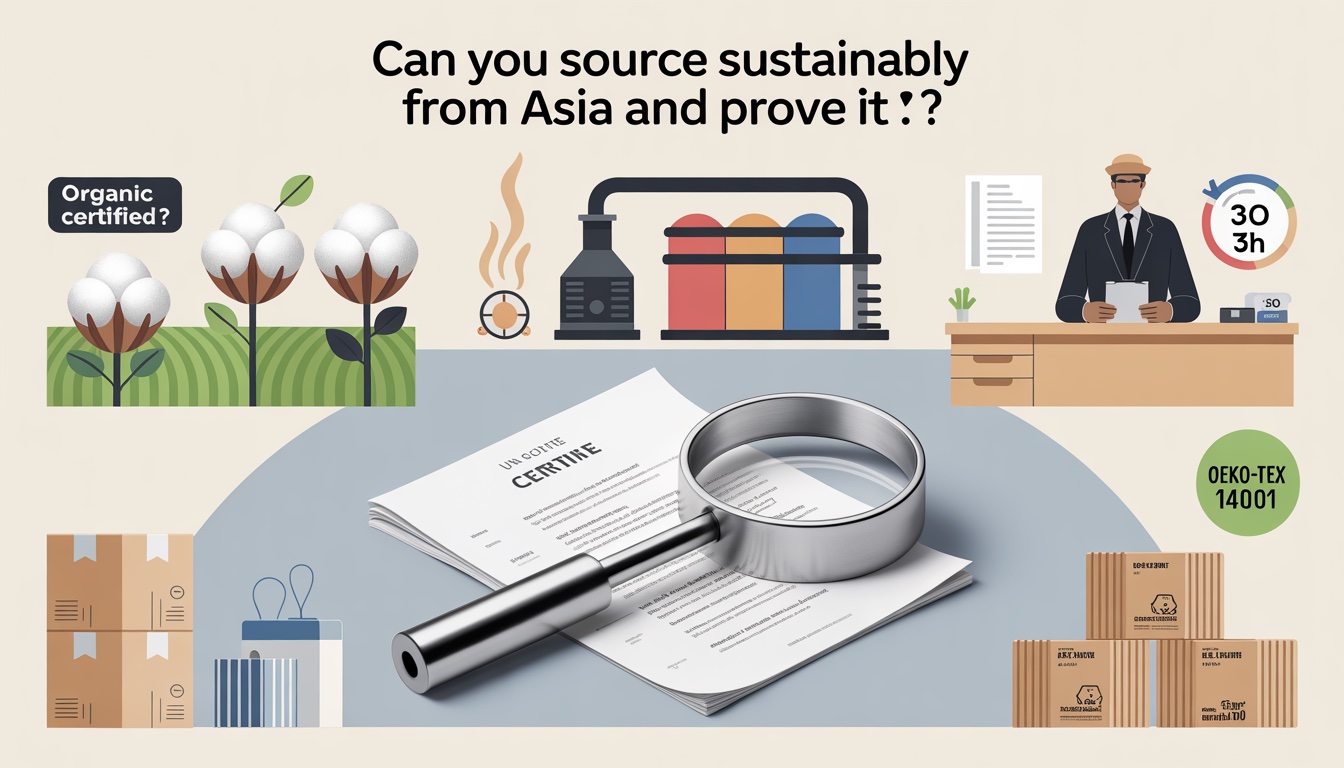
Asian production can be sustainable, but the proof requires more than collecting certificates. We unpack what OEKO-TEX, GOTS, FSC and ISO 14001 actually verify, where audit rigour breaks down, and what a credible eco-sourcing programme has to do beyond the supplier checklist before CSRD and CBAM make the gap legally consequential.
The question arrives in almost every sourcing conversation now, asked with varying degrees of urgency depending on the client's sector and customer base: can we source from Asia — specifically from China — and genuinely claim that the product is environmentally responsible? The short answer is yes. The longer answer, which is the only useful one, requires understanding what the certifications that back that claim actually verify, where their audit frameworks are robust, where they are not, and what an importer who wants to make a credible sustainability claim needs to do beyond collecting certificates.
This article does not argue that Asian production cannot be sustainable. It argues that the question cannot be answered by looking at a certificate. It needs to be answered by understanding what the certificate measures, who conducted the audit, how frequently, at what scope in the supply chain, and what the factory's incentive structure looks like when the auditor leaves. That distinction is not philosophical. It is commercial and legal, and it is becoming more consequential by the quarter as European regulatory frameworks — from the CSRD to the EU Supply Chain Due Diligence Directive — close the gap between what companies claim and what they are required to document.
The Certification Landscape: Four Standards, Four Different Questions
OEKO-TEX Standard 100: Product Safety, Not Environmental Performance. OEKO-TEX Standard 100 is the most widely recognised textile certification in consumer markets, and it is also the most widely misunderstood. Its logo — a stylised leaf with "OEKO-TEX" in green — reads, to most European consumers, as an environmental endorsement. It is not. It is a chemical safety certification.
OEKO-TEX Standard 100 tests finished textile products — yarns, fabrics, accessories, and garments — against a list of approximately 100 harmful substances, including pesticide residues, heavy metals, formaldehyde, pH values, colour fastness standards, and a range of prohibited chemicals under EU REACH regulation and beyond. A product that carries OEKO-TEX Standard 100 certification has been tested and found not to contain harmful substances above defined threshold levels at the point of testing. This is a meaningful consumer safety assurance. It tells you nothing about the environmental impact of how the product was made.
A factory producing certified cotton fabric may discharge untreated dyeing effluent into a local river, operate on coal-fired electricity, and use water in quantities far exceeding best practice for the fibre category — and none of this would invalidate its OEKO-TEX Standard 100 certificate, which was issued on the basis of chemical testing of the finished product, not on the basis of an audit of the production process.
For European importers presenting OEKO-TEX Standard 100 as evidence of sustainable sourcing, the certification is a necessary foundation — it demonstrates that the product is safe — but it is not evidence of environmental responsibility in production. Presenting it as such to customers or in supply chain disclosures is a characterisation that will not survive serious scrutiny.
GOTS: The More Complete Standard, and Why It Is Harder to Fake. The Global Organic Textile Standard (GOTS) is a significantly more demanding framework. To carry the GOTS label, a product must contain a minimum of 70% certified organic fibres (for the "made with organic" label) or 95% (for the full organic label), and the entire production process — from spinning and weaving through dyeing, finishing, and cutting and making — must meet GOTS's environmental and social criteria.
On the environmental side, GOTS prohibits a specific list of chemical inputs at every processing stage, requires wastewater treatment facilities at wet processing operations, sets limits on effluent parameters (AOX, pH, temperature, suspended solids), and restricts the use of plastics in packaging. On the social side, it incorporates ILO core labour standards, prohibiting child labour and forced labour and requiring freedom of association.
GOTS certification requires annual on-site inspection by an approved GOTS certifier. The scope is broader than OEKO-TEX — it covers the production system, not just the finished product — which means that a certifier conducting a GOTS audit is assessing dyeing records, chemical input documentation, wastewater treatment equipment, and worker conditions, not merely testing a fabric sample.
Chinese factories can and do obtain GOTS certification, and for buyers of certified organic cotton, linen, or wool products, GOTS-certified Chinese manufacturers are a legitimate sourcing option. The important caveat is chain of custody. GOTS requires that every entity in the supply chain — the fibre producer, the spinner, the weaver, the dyer, the cut-and-sew factory — holds valid GOTS transaction certificates documenting the transfer of certified material. A GOTS-certified finishing factory buying yarn from an uncertified spinner cannot issue legitimate GOTS certification for the finished product. Audits conducted by MAXAM's supply chain teams have found cases where chain of custody documentation at the yarn level was incomplete or imprecise — not necessarily fraudulent, but insufficient to support a claim that would withstand scrutiny.
FSC: Chain of Custody Over Geography, Not Virtue. The Forest Stewardship Council (FSC) certification applies to wood, paper, and forest-derived products and has two distinct components. FSC forest management certification certifies that a specific forest is managed in accordance with FSC's environmental, social and economic standards. FSC chain of custody certification certifies that a manufacturing facility can track FSC-certified material from its sourcing point through to the finished product.
For European importers sourcing wood-based products — furniture components, packaging, paper products, toy manufacturing, wooden flooring — from China, the relevant certification is chain of custody. A Chinese furniture factory can hold FSC chain of custody certification, which means it has a management system for segregating FSC-certified timber from non-certified material and can produce documentation tracing the origin of certified content in its products.
What FSC chain of custody does not verify is that the timber from which the certified content originated was sourced from a responsibly managed forest in the sense that a European buyer might intuitively understand the term. FSC-certified forests exist globally, including in jurisdictions where the gap between FSC standards and on-the-ground enforcement can be significant. The FSC has faced documented criticism for certifying operations in countries with high rates of illegal logging, where the forest management operations that carry the certificate exist alongside uncertified suppliers whose material enters the same supply chains. For buyers sourcing FSC-certified wood products from China, the chain of custody certificate is a necessary but not sufficient assurance.
ISO 14001: A System Certificate, Not a Performance Certificate. ISO 14001 is the international standard for environmental management systems. A factory certified to ISO 14001 has demonstrated, to the satisfaction of an accredited certification body, that it has a documented environmental management system in place — a system that identifies the factory's environmental aspects (energy use, water use, waste generation, emissions), sets objectives for managing them, and documents procedures for monitoring and continual improvement.
ISO 14001 does not certify that a factory performs well environmentally. It certifies that a factory has a documented system for managing its environmental performance. A factory can be ISO 14001 certified and have environmental outcomes — water discharge quality, energy intensity, waste volumes — that are worse than an uncertified competitor. The standard requires a system; it does not require that the system deliver any specific outcome level.
This distinction matters more in China than in Europe for a structural reason. In European manufacturing, ISO 14001 certification typically exists alongside binding regulatory requirements — effluent discharge permits, energy audits under the Energy Efficiency Directive, waste management reporting — that independently enforce environmental performance floors. In Chinese manufacturing, the regulatory environment varies significantly by province, municipality, and sector. The ISO 14001 management system may be the only formal environmental governance mechanism operating at a given factory, without the parallel regulatory enforcement that gives European certification its broader credibility context.
The Audit Rigour Gap: Why the Same Certificate Means Different Things in Different Places
The question that most European importers do not ask — and that is the most commercially important one — is not "does the factory have this certificate?" but "what did the audit that produced this certificate actually assess, and under what conditions?"
The announced audit problem. The majority of certification audits conducted at Chinese manufacturing facilities, across all the standards discussed above, are announced in advance. The factory knows when the auditor is coming, often days or weeks ahead. This is not a conspiracy; it reflects the logistical reality of scheduling access to a production facility and the certifying body's need to ensure that relevant staff and documentation are available.
An announced audit at a Chinese factory is a materially different event from an unannounced audit. In the days before a known audit, factory management may complete maintenance that has been deferred, ensure that the production line most visible to the auditor is operating with the correct input materials, temporarily suspend any non-compliant practices, and ensure that workers who have been briefed on what to say are positioned in the areas the auditor will see. None of this is unique to China. The difference is the enforcement context — a European factory that misrepresents its practices to a certification auditor faces legal liability under EU product safety law, potential regulatory enforcement, and the public scrutiny that attaches to consumer brands operating in well-developed civil society and media ecosystems. These consequences are not absent in China, but they operate differently and with less consistency.
Certification scope and tier 2/3 suppliers. The most systematic gap in Asian sustainability certifications is scope. Most certifications cover the final manufacturing facility — the factory that completes the product and ships it. They typically do not extend to the supplier network that provides that factory with its inputs.
A GOTS-certified Chinese garment factory sources its certified yarn from an approved supplier and is audited on that basis. The yarn spinner itself may hold its own GOTS certification, but the spinning mill's fibre supplier — the cotton ginner who processed the raw cotton into spinnable form — may not. In a complex textile supply chain, the number of processing steps between raw fibre and finished garment can reach six or seven, and certification scope typically covers two or three of them. The EU Supply Chain Due Diligence Directive (entering phased application from 2024) requires due diligence not merely at the direct supplier level but across the entire value chain — including tier 2 and tier 3 suppliers, raw material producers, and logistics providers. For European companies currently relying on factory-level certifications to demonstrate sustainability compliance, this represents a significant widening of scope that most existing certification frameworks are not designed to address.
Certification body quality is not uniform. ISO 14001 certification can be issued by a globally accredited body such as SGS, Bureau Veritas, TÜV Rheinland, or Intertek — all of which operate with consistent methodology, qualified auditors, and international accreditation oversight — or it can be issued by a smaller domestic Chinese certification body whose accreditation status may be current but whose audit rigour is not demonstrably equivalent.
MAXAM's quality audit team has reviewed ISO 14001 certificates from Chinese factories that were issued by certification bodies with current accreditation credentials but whose audit reports, obtained through the client relationship, showed assessment durations of three to four hours for a 200-person manufacturing facility. A thorough ISO 14001 audit of a complex production environment typically requires two to three days. A three-hour audit cannot assess environmental management system implementation in any meaningful depth; it can verify that documentation exists. Buyers who specify that suppliers must hold ISO 14001 or OEKO-TEX or FSC certification without specifying which certification bodies are acceptable are effectively accepting certificates of widely varying actual rigour under a single label.
What Credible Eco Sourcing from Asia Actually Requires
The foregoing is not an argument that sustainability claims for Asian-sourced products are impossible to make credibly. It is an argument that making them credibly requires more than certificates — it requires a structured verification programme that addresses the specific gaps in the certification frameworks.
Step 1 — Know what each certificate covers and communicate it accurately. OEKO-TEX Standard 100 should be described as a chemical safety certification, not a sustainability certification. FSC chain of custody should be described as supply chain tracking for certified material, with acknowledgement that the ultimate forest management certification may be in a jurisdiction with variable enforcement. ISO 14001 should be described as a management system certification, not an environmental performance certification. This precision may feel commercially awkward — "tested for harmful substances" is a less powerful marketing message than "sustainably sourced" — but it is legally defensible and increasingly required. The EU's Green Claims Directive will require that environmental claims be specific, substantiated, and independently verified before being made to consumers. Vague claims backed by certifications that do not verify what the claim implies will become a legal exposure, not merely a credibility risk.
Step 2 — Extend certification requirements up the supply chain. For products where supply chain depth is significant — textiles, paper products, wood-based goods — requiring certification at only the final manufacturing stage is insufficient. MAXAM's eco sourcing protocol extends certification requirements to at least the fabric or yarn level for textile products, and to the mill or spinning stage for natural fibre supply chains. Where upstream certification is not available, material provenance documentation — fibre origin declarations, timber species declarations, raw material sourcing maps — can partially substitute for certification by demonstrating that the buyer has actively investigated the supply chain rather than passively accepting factory-level certificates.
Step 3 — Conduct unannounced or partially unannounced verification audits. The gap between announced certification audits and actual factory practice can be partially closed by supplementing the certification audit with verification audits that are either unannounced or notified within a shorter window (24–48 hours). These audits are not a replacement for the certification audit; they are a check on whether the practices observed during the announced audit are maintained in ordinary operation.
Unannounced audits at certified Chinese factories have, in MAXAM's experience, found practices including: production of GOTS-certified products on lines that are also used for non-certified production without adequate segregation protocols; wastewater treatment systems that are operational during audit periods and periodically offline in normal production; and chemical input documentation that matches certification requirements for approved chemicals while failing to disclose the use of unlisted inputs in specific production steps. None of these findings invalidate the factory's certificate, but they indicate that the certificate's assurance of ongoing compliance is less complete than the European buyer was relying on it to be.
Step 4 — Distinguish between "certified" and "verified." The most important operational distinction in eco sourcing from Asia is between certification — a third-party attestation of conformity at a point in time — and verification — an ongoing monitoring process that checks actual practice between certification audits. European buyers who treat obtaining a supplier certificate as the endpoint of their sustainability due diligence are building their environmental claims on a single moment of assessed conformity, potentially years old, at a facility that has every incentive to maintain compliant practices during the audit window and weaker incentive at other times. Buyers who supplement certification with ongoing verification — through regular audits, product testing at destination, supply chain data monitoring, and supplier self-reporting protocols — are building claims on a continuous practice, which is both more credible and more defensible under the regulatory frameworks that are coming.
The Regulatory Pressure That Is Changing the Calculation
The commercial case for credible eco sourcing from Asia is not primarily about consumer marketing anymore. It is increasingly driven by regulatory requirements that are becoming legally binding for European companies sourcing from Asia.
The EU Corporate Sustainability Reporting Directive (CSRD) requires companies above defined thresholds — and, through cascade effects, eventually their SME suppliers — to report on environmental and social impacts across their entire value chain. Disclosures must be made against European Sustainability Reporting Standards (ESRS) that specify the granularity of what must be reported: greenhouse gas emissions by scope, water consumption, waste generation, biodiversity impact. These are not categories that can be satisfied by a list of supplier certificates; they require quantitative data from the actual supply chain.
For companies sourcing from China, the CSRD creates a specific challenge: Chinese suppliers are not subject to European reporting requirements and have no mandatory obligation to provide the emissions and impact data that European buyers need for CSRD compliance. Collecting this data requires supplier engagement programmes, data-sharing agreements, and — for suppliers that lack internal measurement systems — support for implementing the emissions accounting and environmental monitoring that CSRD reporting depends on.
The Carbon Border Adjustment Mechanism (CBAM), entering full operational phase in 2026, is a further pressure point. For product categories within CBAM's scope — currently steel, aluminium, cement, fertilisers, electricity, and hydrogen, with expansion likely — carbon pricing applies to the embedded emissions of imported goods. For these categories, the "green" credential of a supplier is no longer a marketing decision; it is a direct cost input that determines the CBAM levy applied at the EU border.
The direction of travel is clear: the cost of unverified sustainability claims is rising, and the cost of genuinely traceable, verified sustainable supply chains — which requires investment in audit depth, supplier development, and data infrastructure — is increasingly justified not just by brand positioning but by regulatory obligation.
The Certificate Is the Beginning, Not the End
The honest answer to the question "can you source sustainably from Asia and prove it?" is: yes, but the proof requires more than the certificate. It requires knowing what the certificate covers, verifying that the practices the certificate implies are maintained in ordinary operation, extending the scope of assurance up the supply chain beyond the final manufacturer, and building the documentation infrastructure that emerging European regulations will require.
This is not a counsel of despair for Asian sourcing. MAXAM's eco product range demonstrates that Asian-sourced products with credible environmental credentials are commercially viable and commercially desirable. What it takes to make that credibility real — rather than implied by a logo on a label — is the kind of structured sourcing programme that treats sustainability verification as an operational discipline rather than a procurement checkbox.
The companies that will be best positioned for the European regulatory environment of 2027 and 2028 are those investing now in the systems, the supplier relationships, and the audit frameworks that will allow them to answer detailed regulatory questions with documented evidence rather than certificates. The certificate is the entry ticket. The evidence is the competitive advantage.
Tags
Sources
OEKO-TEX Association — Standard 100 scope and testing criteria (oeko-tex.com); GOTS — Standard version 7.0, scope and certification requirements (global-standard.org); FSC International — Chain of custody standard and forest management certification (fsc.org); ISO — ISO 14001:2015 environmental management systems standard (iso.org); European Commission — EU Supply Chain Due Diligence Directive (2024/1760/EU); European Commission — CSRD and ESRS reporting standards; European Commission — Green Claims Directive proposal (2023); MAXAM Group — Eco sourcing programme documentation; Textile Exchange — Organic Cotton Market Report 2024.