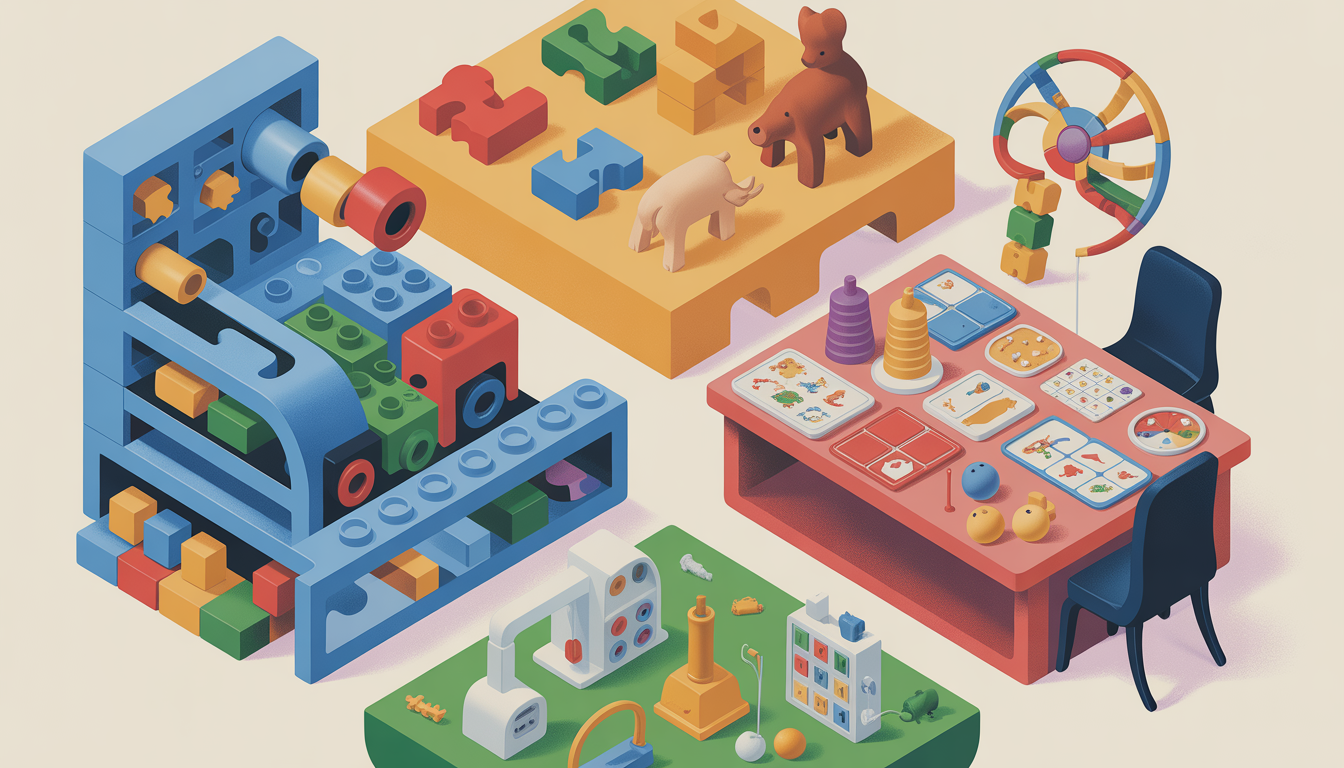
Most European-branded toys are designed in Munich, Paris or Copenhagen — and built in Guangdong. This article maps the manufacturers who chose otherwise: from LEGO and Steiff to Croatia’s UNESCO-recognised wooden toy tradition, the producers that built durable competitive positions on European soil and the strategies that keep them there.
There is an uncomfortable truth at the heart of the European toy industry that the sector’s marketing departments work hard not to advertise: the majority of toys that carry European brand names, designed and conceived in Munich, Paris or Copenhagen, are built in factories in Guangdong Province. The design is European. The trademark is European. The headquarters is European. The factory is not.
This article is not about those companies. It is about the others — the manufacturers who maintained, rebuilt or deliberately chose to keep their production on European soil. They are fewer than they were in 1980, more sophisticated than they were in 2000, and more relevant to the current market conversation than most industry observers expected them to be in 2025. Understanding where they are, what they make, how they survive, and why the competitive pressure from Asia has not eliminated them is one of the more instructive stories in European industrial manufacturing.
The European toy and games market is worth approximately USD 27.8 billion and is projected to grow at 5.7% annually through 2033. European production — genuine industrial manufacturing on EU territory — is concentrated in three sub-regions that each tell a different story: the Nordic-Germanic industrial core (Denmark, Germany, Austria), the Mediterranean innovation cluster (Italy), and the Central and Eastern European traditional base (Czech Republic, Poland, Croatia, Hungary, Slovakia). France sits between these poles with a manufacturing presence that is real but fragmented.
The Criterion That Changes Everything
Before mapping the industry, the criterion must be stated precisely, because the toy sector is particularly prone to blurring the distinction between manufacturing and everything else.
A toy company that designs in Europe and manufactures in China is a design company with a distribution network. That is a legitimate business model — Mattel, Hasbro, and a large proportion of the European licensed toy market operate on exactly this basis — but it does not constitute European toy manufacturing. The test is whether the physical transformation of raw materials into finished toys occurs on European territory, whether workers in European factories are calibrating injection moulding machines, stuffing plush animals, assembling wooden puzzles, or printing playing cards.
By this criterion, the list of genuine European toy manufacturers is shorter than the sector’s public profile suggests — but it is not short. What follows is a geographic and categorical survey of the companies and clusters that meet it.
Denmark: The Nordic Industrial Anchor
No discussion of European toy manufacturing can begin anywhere other than Billund, Denmark, where the LEGO Group has operated its founding factory since Ole Kirk Kristiansen began making wooden toys in 1932 and the iconic plastic brick system was patented in 1958. LEGO is, by any metric, the world’s most successful toy brand — and it is one of the very few at global scale that has doubled down on European production rather than treating it as a legacy cost to be eliminated.
The Group manufactures at two European facilities: its original Danish site in Billund, and its Hungarian plant in Nyíregyháza — the latter now the second-largest LEGO factory in the world. The Hungarian investment is significant both in scale and in timing. Following a €140 million expansion programme completed in September 2025, the Nyíregyháza facility has grown from its original 120,000 m² footprint to 262,000 m², with capacity increased by 30%, over 1,000 injection moulding machines, 73 packaging lines, and a workforce of more than 4,300 people. The expansion added 30,000 m² of built-up area and 300 jobs. LEGO’s decision to invest at this scale in Hungary — rather than following the industry orthodoxy of capacity expansion in Asia — is the single most powerful statement made by any European toy manufacturer about the viability of European production in the decade of the 2020s.
The Nyíregyháza expansion also incorporates sustainability commitments consistent with LEGO’s broader corporate strategy: an 8.61 MWp solar installation added in 2025 (a 200%+ increase over the previous year) and a geothermal heating system that will eliminate the use of non-renewable natural gas by 2028. Europe’s green electricity infrastructure — Hungary’s grid is improving rapidly — becomes a competitive asset when carbon accounting enters the cost of manufacturing.
Dantoy: Quiet Excellence in Danish Plastic. Alongside LEGO’s global scale, Denmark’s second manufacturing pillar is the considerably quieter dantoy, which has been producing plastic toys in Denmark for more than 60 years. Where LEGO represents the global pinnacle of injection moulded precision construction systems, dantoy occupies the more modest but commercially durable segment of outdoor play equipment, sand toys, buckets, watering cans, and educational play sets for young children.
Dantoy’s claim to in-house Danish production is explicit and verifiable — the company’s own history makes the manufacturing location central to its brand identity. More recently, dantoy has committed to producing its toys from bio-based plastics derived from sugarcane — a material substitution that simultaneously addresses sustainability pressure and differentiates the product from standard petroleum-derived Chinese alternatives. In May 2024, the company supplied Playmobil-branded toys made from 95% sugarcane plastic for McDonald’s Happy Meals in Germany, demonstrating that bio-based European toy production has reached a scale of industrial practicality.
Germany: The Historical Powerhouse and Its Evolution
Germany is the largest toy market in Europe by consumer spending and was, according to EUIPO data, the leading producer of toys and games in the EU by value — a position that reflects both its consumer scale and the durability of its manufacturing base. The German toy industry is concentrated in Bavaria and Baden-Württemberg, with a secondary cluster in the Erzgebirge (Ore Mountains) region of Saxony, which has produced wooden decorative and toy items since the seventeenth century.
Playmobil: The Figurine Empire and Its Restructuring. Playmobil, manufactured by the Geobra Brandstätter Group in Zirndorf, Bavaria, is one of the most recognisable toy brands in Europe. The system — plastic figurines with a distinctive rounded aesthetic, produced in themed playsets — was launched in 1974 and has generated over 4 billion figures worldwide. Playmobil’s manufacturing footprint was historically binational: primary production in Zirndorf (Germany) and a substantial operation at the Ħal Far industrial zone in Malta.
The company underwent a "fundamental restructuring" in 2023, announcing approximately 700 job cuts globally in response to what management described as the worst market conditions since World War II — a combination of post-pandemic demand normalisation, supply chain cost inflation, and the Ukraine war’s impact on energy and materials. Crucially, the Malta plant was assessed as unlikely to bear the brunt of these cuts. The Maltese facility, which produces injection-moulded components for the Playmobil system, continues to operate as part of the restructured group. Malta’s EU membership, competitive industrial costs, and the density of tooling expertise built up over decades of Playmobil production makes the operation difficult to replace in the short term.
Ravensburger: The Puzzle and Board Game Giant Who Kept Its Factories. Ravensburger AG, founded in 1883 in the town of Ravensburg in Upper Swabia, is the European market leader in jigsaw puzzles and one of the continent’s most significant board game manufacturers. Unlike many of its peers, Ravensburger has maintained actual production facilities rather than transitioning to a pure design-and-distribute model. The company runs its own manufacturing plants in three EU locations: Ravensburg (Germany), Polička (Czech Republic), and Banská Bystrica (Slovakia). These are not final assembly operations — they are full production facilities processing paper, cardboard, plastics, and printed materials into finished games and puzzles.
Ravensburger’s brand recognition exceeds 90% among German consumers, and the company exports globally across its puzzle, game, and children’s book categories. Its continued investment in European manufacturing reflects a calculation shared by several premium segment producers: the cost premium of European production is offset by quality control consistency, speed-to-market for European retail, and the brand credibility that attaches to verifiable European manufacturing.
Steiff: The Oldest Plush Toy Manufacturer in the World. Margarete Steiff GmbH, founded in 1880 in Giengen an der Brenz by the seamstress Margarete Steiff, holds a place in the plush toy industry that no competitor has been able to replicate in 145 years: it is the oldest manufacturer of plush toys in the world, the creator of the first modern teddy bear (the "Bear 55 PB" designed by Richard Steiff in 1902), and a brand whose entry-level product is positioned as a premium collectible rather than a commodity toy.
Steiff continues to manufacture in Giengen — a specific and deliberate choice that the company links directly to its brand story. A Steiff bear made in China would not be a Steiff bear in any commercially meaningful sense; the product’s premium price and collector status depend on the credibility of its German origin. At its production peak in 1907, Steiff produced 1.7 million toys and more than 970,000 teddy bears annually. Today’s production is more targeted toward the premium and collector segments, but the Giengen factory remains the source of Steiff’s most significant product lines.
Haba: Wooden Toys and Games from Bad Rodach. Haba (Habermaaß GmbH), based in Bad Rodach in Bavaria, is a manufacturer of wooden toys, games, and children’s furniture that has maintained German production throughout its history. Known for developmentally oriented wooden toys for toddlers and young children, and for a board game range that is explicitly positioned around family play, Haba represents the continuation of a specifically German tradition of combining educational philosophy with artisanal material quality. Its production in Germany — using FSC-certified timber from regional sources — is part of a product positioning that commands a meaningful premium over Asian commodity alternatives.
Piatnik (Austria): Playing Cards Since 1824. Across the border in Vienna, Piatnik — founded in 1824 and still family-owned — is one of Europe’s oldest and most continuously operating game manufacturers, producing playing cards, board games, and card games from its Vienna facility for two full centuries. The longevity is itself a competitive argument: a company that has been manufacturing games in the same location since the reign of Emperor Franz I of Austria has accumulated a specific institutional knowledge, a portfolio of intellectual property, and a set of supplier and distribution relationships that are not easily replicated by a lower-cost entrant. Piatnik exports across Europe and is particularly strong in the German-speaking markets and Eastern Europe.
Italy: The Most Balanced European Toy Economy
Italy occupies a distinctive position in the European toy manufacturing landscape: it is the EU country that comes closest to matching classical toy manufacturing strength with technical and educational toy production, and it does so in a single company that is both a case study and a benchmark.
Clementoni: 90% Made in Recanati. Clementoni S.p.A., founded in 1963 by Mario and Matilde Clementoni in Recanati (Marche region), is the paradigm case of a European toy manufacturer that has chosen depth of integration over geographic arbitrage. The company’s own data is striking: 90% of its overall production process takes place in Recanati, and approximately 60% of total production by unit count is manufactured at the Recanati factory itself — a figure that covers toys with paper and cardboard components (including the iconic Sapientino educational toy, launched in 1967, and puzzles), as well as classic building blocks.
With revenues of approximately €129 million, 411 employees, and exports to more than 80 countries (with international sales now representing almost 70% of turnover, up from 29% in 1996), Clementoni demonstrates that a mid-sized European toy manufacturer can build a genuinely global business on the foundation of integrated European production. The company’s product range spans puzzles, board games, electronic educational toys (the Science Museum range), coding and STEM kits, and creative play materials — a breadth that straddles the classical and technical categories more completely than any other EU-based manufacturer.
The presence of electronic components in Clementoni’s range raises the question that the electronic toy category poses throughout Europe: where do the semiconductors, sensors, and microcontrollers come from? The honest answer is that for educational electronic toys made anywhere in Europe, the underlying electronic components are predominantly Asian in origin. What Clementoni does — and what distinguishes it from the pure design-and-distribute model — is complete the full product development, tooling, manufacturing, and quality assurance cycle in Recanati, importing components but maintaining European control over the transformation process.
France: A Fragmented but Real Manufacturing Base
France’s toy manufacturing industry is smaller than its European neighbours’ and less well-documented, but it persists in specific niches that are commercially significant and culturally distinctive.
The Jura: France’s Wooden Toy Capital. The Jura region — specifically the area around Moirans-en-Montagne in Franche-Comté — is the historic centre of French wooden toy manufacturing, a concentration that developed in the eighteenth century when the region’s abundant timber and long winters drove craftsmen to indoor manufacturing. Moirans-en-Montagne is home to a toy museum (Musée du jouet) and remains a production centre for wooden and creative toys. Vilac, one of France’s most recognised wooden toy brands, continues to manufacture in the Jura, maintaining a product range of wooden pull toys, musical instruments, push toys, and memory games that explicitly positions European craftsmanship as its core commercial argument. Jeujura is a further Jura-based producer maintaining local production of wooden puzzles and educational games.
Motriconcept and the Educational Toy Segment. Motriconcept, based in Normandy, maintains creation and manufacturing units for motor-skills and educational toys aimed at the early childhood professional market — crèches, schools, and therapeutic settings. This B2B orientation is common among French toy manufacturers that have survived: serving professional buyers rather than mass retail protects margins, reduces the pricing pressure that comes from direct comparison with Chinese alternatives on retail shelves, and creates the kind of specification-driven demand that rewards European manufacturing quality.
Stuffed Toys: Sandy Peluches and the Residual French Segment. In the stuffed toy segment, Sandy Peluches and a network of smaller French ateliers maintain genuine domestic production. The scale is modest compared to the mass market, but these producers occupy a specific position serving the premium gifting, institutional (children’s hospital play), and traceability-conscious consumer segments that are growing alongside broader sustainability awareness.
Belgium: The World’s Oldest Card Manufacturer
Belgium’s claim to European toy manufacturing status rests primarily on a single institution whose scale and historical depth are unmatched anywhere on the continent.
Cartamundi: Cards, Games and the 1765 Benchmark. Cartamundi, headquartered in Turnhout (Antwerp province), has operated printing presses since 1765 — making it the world’s oldest continuously operating manufacturer of playing cards, and by extension one of the pillars of the board game physical production industry. Today the company is the world’s largest manufacturer of playing cards and board game components, operating 13 manufacturing facilities globally, including plants in Belgium, Germany, France, Hungary, Ireland, Italy, Poland, and the United Kingdom. The Turnhout headquarters remains the operational and manufacturing core.
The significance of Cartamundi to the European toy and games industry is not fully captured by its brand visibility — it is a B2B manufacturer rather than a consumer brand. But every Monopoly set, every UNO deck, every Pokémon card pack, every Magic: The Gathering booster produced for the European market passes through Cartamundi’s industrial system. The company makes the physical product that hundreds of branded game publishers sell. In 2024, Cartamundi announced an expansion of its Turnhout facility to meet growing demand for collectible card games — a market segment where physical card quality is a direct determinant of game playability and collector value.
Central and Eastern Europe: The Underestimated Manufacturing Base
The most significant underestimation in generic analyses of European toy manufacturing is the contribution of Central and Eastern European producers — particularly in the traditional toy categories that global market research tends to treat as declining or marginal. For stuffed animals and wooden toys specifically, this region is not a secondary player: it is the European production core.
Czech Republic: The Most Complete Eastern European Toy Cluster. The Czech Republic combines a long artisanal tradition with genuine industrial production capability in both wooden toys and textile toys. Moravská Ústředna Brno is documented as one of the largest European producers of textile toys and stuffed animals, with a production tradition that predates the communist era and has survived multiple structural transformations of the Czech economy. The company’s products are sold across European specialist retail channels and through B2B distribution to educational and institutional buyers.
Czech wooden toy production is equally deep, with multiple manufacturers maintaining fully localised production and a distribution network — including specialist ethical toy retailers like Jeu Jouet Éthique, which explicitly sources Czech-made wooden toys — that validates the commercial credibility of the cluster. The Czech toy tradition has a cultural identity that functions as a marketing asset: buyers in France, Germany, and Scandinavia who seek traditional European wooden toys specifically know the Czech origin as a quality signal.
Croatia: UNESCO Recognition for Hrvatsko Zagorje. In the Hrvatsko Zagorje region of northern Croatia, the traditional manufacture of wooden toys has been recognised by UNESCO as an Intangible Cultural Heritage of Humanity — a designation that is simultaneously a cultural honour and a commercial differentiator of the highest order. The wooden animals, vehicles, and decorative toys produced in this tradition are not museum pieces: they are active objects of commercial production, sold through specialist toy retailers across Europe and exported to markets where the UNESCO provenance is understood as a mark of authentic artisanal heritage. For a European buyer choosing between a Croatian UNESCO-heritage wooden toy and a Chinese equivalent made from undocumented timber, the choice is not primarily about price.
Poland: Scale in Wood and Plush. Poland’s toy manufacturing base is broader and more diffuse than the Czech cluster, but it is substantial. In wooden toys, Polish manufacturers — many of them artisan-scale or small-medium enterprises — produce solid wood construction toys, educational puzzles, and early learning materials, supported by Poland’s significant forestry resource base. In stuffed toys, Poland appears consistently in European B2B directories as a source country for plush animal production and toy accessories, reflecting both the labour cost differential with Western Europe and the manufacturing tradition that developed under the communist-era toy industry.
Hungary: From Production Recipient to Production Hub. Hungary’s position in the European toy manufacturing landscape has been transformed by the LEGO investment. The Nyíregyháza plant, now expanded to become the world’s second-largest LEGO factory, has placed Hungary among the top three EU toy producers by volume — alongside Italy and Germany. Beyond LEGO, Hungary also hosts a Cartamundi manufacturing facility, confirming the country’s emergence as a significant production location for consumer goods with European quality standards and relatively competitive operating costs.
Board Games: Europe’s Most Defensible Category
If there is one category within the toy and games industry where European manufacturers have maintained the most complete and least contested competitive position, it is board games — and particularly the segment that the industry has come to call "Euro games": strategy and family board games designed according to a specific design philosophy that has dominated the global premium board game market for three decades.
The phenomenon known as the "German board game" — really a broader Central European tradition centred on accessible strategic gameplay, minimised player elimination, and high production quality — is not a marketing concept. It reflects a specific product development culture that emerged from the intersection of Germany’s strong family game tradition, the intellectual climate of the post-1960s Spiel culture, and the manufacturing infrastructure of Ravensburger, Kosmos, and their peers.
Kosmos (Stuttgart), publisher of the globally successful EXIT: The Game series and a wide range of family strategy games, maintains European production through its own facilities and contracted German print-and-packaging manufacturers. Schmidt Spiele (Munich) operates similarly, with production processes rooted in German printing and board manufacturing. The physical quality of these games — cardboard density, component weight, ink quality, box construction — is a direct product of European manufacturing standards and supply chain management that is genuinely difficult to replicate through Chinese outsourcing at the same price point.
The board game segment has also experienced a renaissance driven by the "kidult" phenomenon — adult buyers purchasing games for their own play rather than for children — and by the success of crowdfunding platforms like Kickstarter, which have enabled smaller European game publishers to finance production runs without the capital requirements that previously made entry-level production prohibitive. This democratisation of board game publishing has created a larger ecosystem of European game publishers, most of whom continue to manufacture in Europe through companies like Cartamundi and regional print-and-play manufacturers in Germany, Poland, and the Czech Republic.
Electronic Toys: The Hardest Battleground
Electronic toys are where the honest assessment of European manufacturing must be most measured. The plain reality is that the manufacture of consumer electronic goods — including toys with chips, sensors, speakers, screens, and connectivity — has been almost entirely captured by Asian manufacturing ecosystems, and specifically by the Chinese Pearl River Delta and Yangtze River Delta clusters, over the past thirty years.
The reasons are structural and reinforcing. Electronic component manufacturing requires proximity to the semiconductor supply chain, which is concentrated in East Asia. The tooling for plastic enclosures, the assembly of printed circuit boards, the integration of displays and batteries — all of these processes are optimised in Chinese factories at cost levels that European production cannot approach. Even European companies that originated in Europe and retain European brand identity have largely migrated their electronic toy production to China.
VTech, frequently cited in European toy industry analyses as a European electronic toy manufacturer, is in fact a Hong Kong-incorporated company (VTech Holdings) whose toys are designed partly in European offices but manufactured in China. The European "presence" of VTech is a commercial and marketing operation, not a manufacturing one. By the strict criterion applied throughout this article, VTech does not qualify as a European toy manufacturer.
The notable exception, and a significant one, is Clementoni. Its Science Museum range — electronic science kits, coding and robotics products for children, STEM learning systems — are developed and largely produced in Recanati. Where electronic components are imported (as they inevitably are), the assembly, quality testing, and finalisation occur in Italy. This is not the same as making a smartphone, but it represents the most credible European position in the educational electronics segment.
The structural constraint for European manufacturers in this category is not capability but capital and supply chain architecture. Building a vertically integrated electronic toy manufacturing operation in Europe would require access to semiconductor supply chains that do not currently exist at sufficient scale on the continent — the situation that the EU Chips Act is attempting, slowly and expensively, to address at the industrial rather than toy-industry level. In the medium term, European toy companies making electronic products will continue to be European in design, IP, and brand while importing the core electronic elements from Asia.
The Chinese Competitive Threat: Scale, Speed, and the Response
China’s position in global toy manufacturing is not a competitive threat in the conventional sense — it is the structural baseline against which all other producers are measured. China supplies more than 70% of the world’s toys by volume, and Chinese toy exports reached $48.36 billion in 2022 — representing over 80% of global toy export value. In Guangdong Province alone, approximately 6,000 toy-making businesses employ 1.5 million workers. Automated production lines have reduced manufacturing costs by over 40% in the past decade, and smart factories running 24/7 with robotic arms and sensors have improved productivity by approximately 70%.
These numbers are not a problem that can be solved by incremental efficiency improvements in European factories. They represent a structural cost differential that European manufacturers cannot close on price alone. The €27.8 billion European toy market coexists with massive Chinese production because European manufacturers have found and held positions where competing on price is not the primary logic — and because the regulatory, safety, and cultural architecture of the European market creates barriers that Chinese producers, despite their manufacturing advantages, cannot simply purchase their way through.
Safety regulation as a structural moat. The EU’s EN71 toy safety standard — and its expression through the CE marking requirement — is the single most structurally important competitive advantage that European manufacturers hold. EN71 is one of the most comprehensive toy safety frameworks in the world, covering mechanical and physical properties, flammability, chemical properties (including 19 categories of heavy metals, 11 more than the US equivalent ASTM F963), and labelling requirements. The chemical restrictions include antimony and selenium content limits of ≤60 ppm on all accessible parts, applied to paint, plastic, and fabric simultaneously.
European manufacturers are intrinsically compliant with these standards because they operate under them continuously. A Chinese manufacturer seeking to export to Europe must invest in EN71 compliance certification, third-party testing, documentation, and import inspection — costs that add meaningfully to the landed cost of Chinese goods and that do not apply to European-made products. More importantly, European manufacturers who encounter a compliance failure in their own production can address it immediately in their own factory; a Chinese manufacturer whose product fails EN71 testing at European customs faces recall costs, shipping reversals, and reputational damage that are disproportionately more expensive. The regulatory convergence happening through the EU’s broader product safety framework — including new requirements on chemical transparency, recycled content labelling, and digital product passports for toys — will strengthen this advantage progressively.
Premium positioning and the trust premium. The most consistent response strategy among European toy manufacturers is the deliberate occupation of price tiers where the "Made in Europe" signal functions as a purchasing criterion rather than simply a cost explanation. Steiff teddy bears retail at prices that Chinese plush manufacturers cannot approach for reasons that have nothing to do with materials or labour cost — they reflect a brand story, a heritage, a collectibility, and a quality guarantee that the Giengen factory location makes credible. LEGO bricks command a premium not because Danish or Hungarian injection moulding is physically different from Chinese injection moulding, but because decades of quality consistency and the company’s explicit manufacturing commitment create a trust that parents extend to a product destined for their children’s play.
This trust premium is not irrational. EN71 compliance can be certified but not guaranteed; a toy made in a European factory under continuous quality management provides a different assurance profile than a product imported from a supplier audited once annually. For parents purchasing toys for infants and toddlers, this distinction is commercially significant.
Sustainability as competitive strategy. The third major European response to Asian competition is the acceleration of sustainability positioning. In May 2024, dantoy’s bio-based plastic toy range — manufactured in Denmark from sugarcane-derived polymers — demonstrated that European manufacturers can use material innovation to create a differentiation that goes beyond price and heritage. FSC-certified wood sourcing is now standard practice among European wooden toy manufacturers, providing a verifiable environmental credential that Chinese manufacturers using unspecified timber cannot credibly match. Ravensburger’s German manufacturing facilities operate on a significant proportion of renewable energy, providing a carbon footprint per unit that is structurally lower than production from coal-heavy Asian grids — a distinction that CBAM will progressively monetise. The growing "eco-toy" and "sustainable toy" segment plays systematically to European manufacturing’s structural advantages: shorter supply chains mean lower transport emissions, EU environmental law mandates material disclosure, and the cultural alignment between European sustainability values and European manufacturing provenance creates a natural marketing proposition.
The Map in Full: Regional Strengths and Gaps
A complete geographic survey of EU toy manufacturing reveals a sector that is more regionally diverse than its public image suggests, but also more stratified by category than any single country profile captures.
Nordic Europe (Denmark, Finland, Sweden) is strongest in premium construction and plastic toys (LEGO, dantoy) and in educational wooden toys, but essentially absent from electronic toy manufacturing and mass-market stuffed animals.
Western Europe (Germany, France, Belgium, Austria) holds the most historical depth across all categories except electronic consumer toys. Germany’s Ravensburger and Steiff represent the highest brand-value expressions of European toy manufacturing. France’s Jura cluster maintains wooden toy production. Belgium’s Cartamundi holds a structurally dominant position in physical game components. Austria’s Piatnik connects the current industry to its pre-industrial origins.
Southern Europe (Italy, Spain, Portugal) is led by Italy’s Clementoni, the most technically sophisticated mid-sized European toy manufacturer. Spain has a history of toy manufacturing — particularly in the Ibi region of Alicante, which hosted a significant toy cluster through the 1990s — but the documented evidence for complete integrated Spanish toy manufacturing at major-brand scale is weaker than for the countries discussed above.
Central and Eastern Europe (Czech Republic, Poland, Croatia, Hungary, Slovakia) is the most underestimated sub-region, particularly for traditional categories. The Czech Republic’s Moravská Ústředna represents the best European case for textile and stuffed toy manufacturing at industrial scale. Croatia’s UNESCO-recognised wooden toy tradition is a cultural asset with direct commercial application. Poland’s diffuse network of wooden toy and plush manufacturers is real, export-oriented, and commercially underexposed to Western European buyers. Hungary’s transformation through the LEGO investment has made it a tier-one EU toy manufacturing location.
The Manufacturers Who Prove the Model Works
The European toy manufacturers who still make on European soil are not anachronisms or protected cottage industries — they are businesses that have found sustainable competitive positions in a global market dominated by Chinese production at a cost advantage that cannot be matched directly. They have done so through three interlocking strategies: occupying the premium price tier where European origin is a purchasing criterion (Steiff, Ravensburger, Croatian wooden toys); investing in compliance and safety credibility that Asian manufacturers must buy while European manufacturers simply inhabit (EN71 compliance as structural moat); and accelerating material and process sustainability as a differentiator that regulatory trends are progressively monetising (dantoy bio-plastic, FSC wood, renewable energy manufacturing).
What they have not done — and cannot credibly do — is compete with China on electronic toy manufacturing at scale. This is the category where the honest verdict is that European manufacturing is present only in the educational niche (Clementoni, Haba) and absent from the consumer electronics toy mainstream. The EU’s Chips Act trajectory and the gradual reshoring of European electronics manufacturing may, over a decade, shift this picture — but not in the timeframe that current investment cycles address.
The most durable observation is this: the European toy companies that have survived and thrived are precisely those that chose not to replicate what China does better. They chose instead to do what China cannot easily do — accumulate heritage, enforce safety, certify sustainability, and tell a story of provenance that a parent putting a toy in a child’s hands finds worth paying for. The brick moulded in Nyíregyháza, the bear sewn in Giengen, the puzzle printed in Ravensburg, the playing card pressed in Turnhout: these are not merely products. They are arguments, made in material form, for the proposition that European manufacturing has a future precisely because it stopped trying to be cheap and started being irreplaceable.
Tags
Sources
IndexBox — European toy market overview 2024 (indexbox.io); LEGO Group — Hungary factory expansion inauguration, September 2025 (lego.com); Clementoni — company profile and production data (clementoni.com); Ravensburger — manufacturing locations and company history (ravensburger.com, jigsaw.blog); Steiff — company history and founding (corporate.steiff.com); Cartamundi — production and expansion announcement (cartamundi.com); Playmobil restructuring — Malta plant, autumn 2023 (playmofriends.com, maltatoday.com.mt); Dantoy — company history and bio-plastic production (dantoy.dk, svanemaerket.dk); Moravská Ústředna Brno — Czech traditional toy manufacturing (radio.cz); UNESCO — Hrvatsko Zagorje wooden toy tradition (ich.unesco.org); EUIPO — Toys and games IP study (euipo.europa.eu); Market Data Forecast — Europe toy market 2033; Expert Market Research — Europe toys market 2035; QIMA — EU Toy Directive EN71 (qima.com); Intertek — EU Toy Directive EN71 (intertek.com); GS&NMC — Chinese toy manufacturing dominance (gsnmc.com).