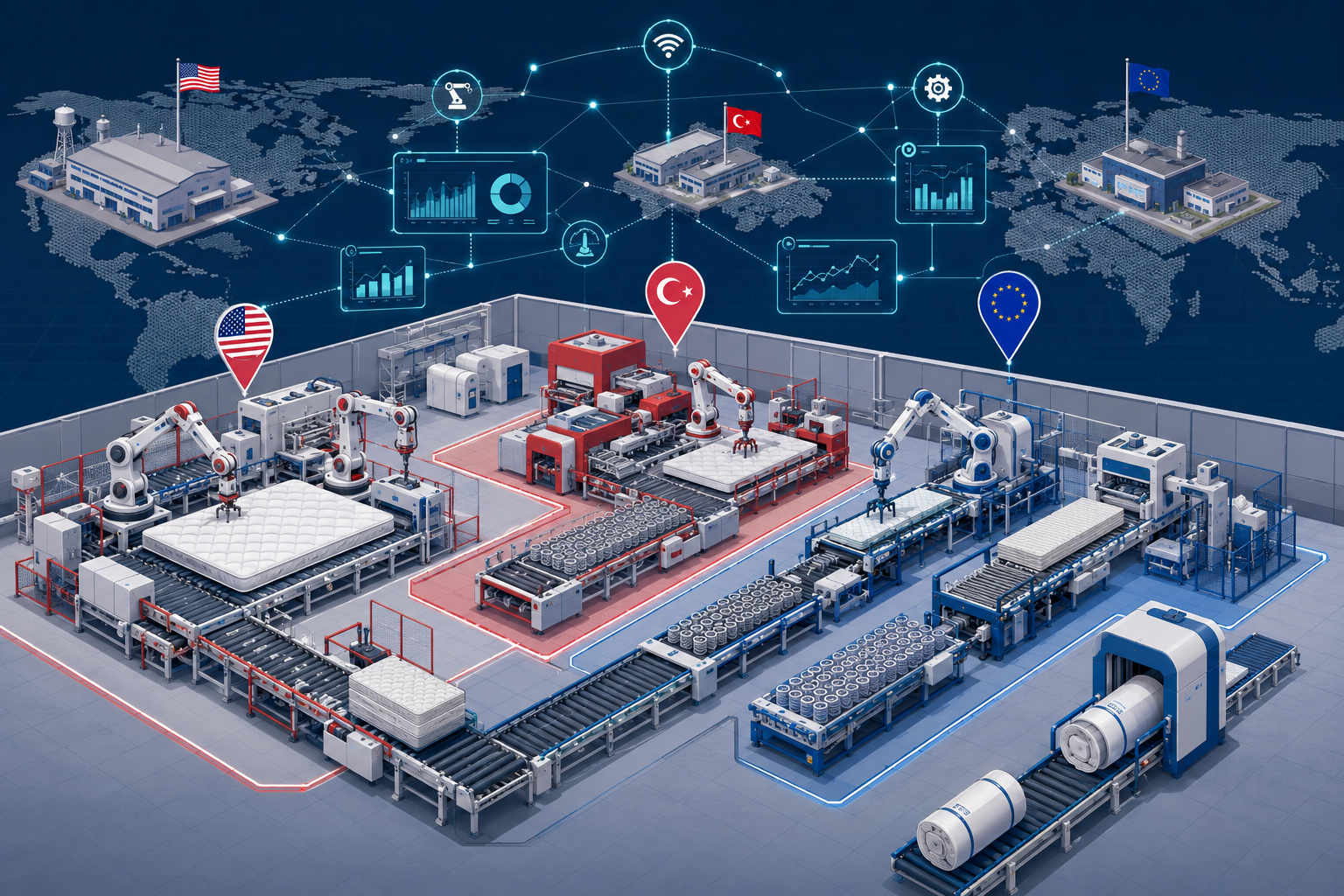
Two announcements eighteen months apart — ABM International’s roll-up of America’s legacy machinery brands and Somnigroup’s $2.5 billion acquisition of Leggett & Platt — have reshaped the North American mattress equipment market more completely than anything in six decades. We map the new American landscape, the global machinery players from Turkey to China, and the five structural trends defining the next decade.
Two announcements, made eighteen months apart, have restructured the North American mattress machinery market more completely than anything that preceded them in six decades. In March 2025, ABM International — a Texas-based sewing and bedding equipment group — quietly acquired three legacy American machinery brands from Leggett & Platt, ending a rivalry that had defined the US market since the 1960s. And in April 2026, Somnigroup International announced it would acquire Leggett & Platt itself in an all-stock deal valued at approximately $2.5 billion — the largest vertical integration in the history of the American mattress industry.
Together, these two movements answer a question that equipment manufacturers, component suppliers, and mattress producers worldwide have been asking since 2020: who, exactly, controls the future of the American bedding supply chain?
The answer, increasingly, is Somnigroup. And the implications of that answer reach well beyond North America.
This article maps the new American landscape that consolidation has created, surveys the global machinery players — from Turkish ambition to Chinese volume to European specialisation — and sets out the five structural trends that will define equipment procurement through 2031.
Part I — Leggett & Platt: The Quiet Giant That Could No Longer Afford to Stand Still
To understand what is happening in 2026, it is necessary to understand what Leggett & Platt was — and what it could no longer sustain being.
For more than 130 years, Leggett & Platt (NYSE: LEG) was one of the most consequential companies in the global bedding industry that most consumers had never heard of. It supplied the innersprings inside Sealy mattresses, the adjustable base mechanisms inside Tempur-Pedic beds, the wire forms and foam components that disappeared inside finished products carrying other brands. In the 1990s, it extended its reach into capital equipment by acquiring Gribetz International and Porter International — two of America’s most established mattress machinery names — making it a rare industrial entity that operated simultaneously as a component supplier and a machinery manufacturer to the same downstream customers.
The logic had been internally coherent: owning both the machines that made mattresses and the components that went inside them gave Leggett & Platt an unparalleled depth of relationship with American mattress manufacturers. Customers were, in practical terms, dependent on L&P across multiple points of their production system simultaneously.
By 2024, that position had become untenable to sustain profitably. Revenue pressure and declining margins in bedding — driven by post-pandemic demand normalisation, the entry of lower-cost competitors, and the structural shift in US mattress retail toward direct-to-consumer and compressed-format products — forced a fundamental reconsideration. Leggett & Platt announced a restructuring targeting $40–50 million in annual EBIT benefit through the consolidation of 15 to 20 of its 50 production and distribution facilities. The machinery businesses — strategic assets when acquired, but peripheral to the core components position the company needed to defend — were the first to go.
ABM International: Building an American Machinery Giant at Speed
The acquirer of the Gribetz and Porter businesses was ABM International, a private company based in Montgomery, Texas, specialising in sewing equipment and specialised mattress manufacturing machinery. What happened over the following twelve months was a consolidation sequence that moved at a speed unusual in a sector not known for rapid structural change.
In March 2025, ABM acquired Gribetz International, Porter International, and Galkin — the three machinery businesses Leggett & Platt was divesting — along with two factories in Florida and Missouri, 70 employees, and approximately 100,000 square feet of manufacturing and service capacity.
By late 2025, ABM had added Atlanta Attachment Company, an independent Georgia-based group founded in 1969 that had built a formidable position in border, panel, and ruffle sewing machinery for the bedding industry. Atlanta Attachment brought with it 86 employees, over 238,000 square feet of facilities, and its proprietary Pattern'N'Pattern® quilting technology.
Also acquired in late 2025 was Atlantic Automation Co., adding engineering capability and service integration to what was now becoming a genuinely full-line American machinery group.
The consequence of this consolidation sequence is stark: after competing for more than fifty years, Gribetz and Atlanta Attachment — America’s two largest mattress machinery names — are now under the same ownership. The combination represents over 150 years of accumulated manufacturing history in a single entity. ABM International can now offer any US mattress factory a complete machinery package covering quilting, border sewing, tape edge finishing, and automation — from a single American supplier, with a US-based service network, and with the brand recognition that comes from eight decades of customer relationships built by the companies it has absorbed.
Somnigroup: When the Mattress Maker Buys Its Supplier
The second and larger transformation arrived in April 2026 with Somnigroup International’s announcement that it would acquire Leggett & Platt in an all-stock transaction valued at approximately $2.5 billion.
Somnigroup itself was created in February 2025, when the newly renamed Tempur Sealy International — combining the Tempur-Pedic, Sealy, and Stearns & Foster manufacturing brands — completed its $5 billion acquisition of Mattress Firm, the largest US mattress retail chain with over 2,000 stores. Listing on the NYSE as SGI, Somnigroup emerged as an entity spanning the full consumer-facing value chain: manufacturing premium branded mattresses and selling them through its own retail network.
The acquisition of Leggett & Platt extends that integration one step further upstream. Somnigroup and L&P had collaborated for nearly fifty years; L&P supplies the innersprings and components that go inside Somnigroup mattresses. By owning L&P, Somnigroup will, once the transaction closes — expected by end-2026 — control its complete supply chain: from raw material input (springs, foam, wire forms) through manufacturing to retail.
The combined entity will operate approximately 175 manufacturing facilities across 36 countries, employ over 36,000 people, and generate roughly $11.2 billion in net sales. It is, by any measure, a vertically integrated bedding conglomerate with no precedent in the industry’s history.
The implications for the competitive landscape are significant. A Somnigroup-owned Leggett & Platt will logically prioritise internal supply to Somnigroup brands. Independent US mattress manufacturers who currently source innersprings and components from L&P — and there are many of them, from regional producers to mid-size national brands — face the prospect of a major supplier whose priorities have fundamentally shifted. Securing alternative component supply, and investing in production efficiency to compensate for any cost increase that alternative sourcing entails, will be commercial imperatives for these producers. That investment cycle creates demand — and that demand creates opportunity.
Part II — Turkey: The World’s Workshop for Mattress Equipment
While the American market was consolidating, the Turkish manufacturers who have spent fifteen years building the dominant position in global mattress machinery supply were watching, recalibrating, and — in at least one case — absorbing a significant structural setback of their own.
Elektroteks, headquartered in Bursa and operating from a facility exceeding 450,000 square feet, remains the world’s largest producer of mattress machinery by volume. Exporting to over 120 countries, Elektroteks has built a comprehensive product range spanning pocket spring assembly, coil systems, quilting lines, border equipment, and — increasingly central to its commercial proposition — the BEDLINE concept: a modular, automated production architecture in which machines communicate and synchronise throughout the manufacturing sequence, reducing human intervention at each transfer point. The BEDLINE system is Elektroteks’s answer to the automation imperative that is now reshaping machinery procurement decisions globally.
Mert Makina, based in Kayseri, had moved aggressively toward the North American market through its November 2023 merger with the Florida-based United Mattress Machinery — a transaction that was announced as creating a transatlantic equipment business with access to over 110 countries. That strategy has since unwound: the United Mattress Machinery partnership has dissolved, removing Mert Makina’s direct American channel and requiring it to rebuild a US commercial structure from the ground up. The timing is difficult: the acquisition by ABM International of Gribetz and Atlanta Attachment — two of the legacy American players that might otherwise have served as partnership or distribution vehicles — has simultaneously removed the most obvious structural partners. Mert Makina is rebuilding its US presence in a market where the competitive landscape has just become considerably more concentrated.
The dissolution is a setback, not a disqualification. Mert Makina’s product range — including newly developed border and sewing machines that extend its line toward completeness — and its cost competitiveness relative to American equipment remain real advantages in a market where independent producers are under margin pressure. Turkish machinery is approximately 25 to 40% cheaper than comparable American-built equipment. For mid-size US mattress makers not affiliated with Somnigroup and facing the combination of component supply uncertainty and ABM’s premium pricing, that gap is commercially material.
Lineer Makina, also in the Kayseri cluster and established in 2011, maintains a focused position in spring and forming equipment — a narrower product range than Elektroteks or Mert Makina, but technically competitive in the mid-market segment and commercially active in export markets.
Europe: Precision, Service, and the Search for Defensible Positions
The established European machinery manufacturers — principally Italian and Spanish — have spent the better part of a decade adapting to a competitive environment that Turkish volume production has fundamentally reset. The cost structure of European manufacturing makes it commercially indefensible to compete on price for standard-specification equipment. The strategy that has emerged across European suppliers is one of progressive specialisation toward the segments where technical differentiation commands price premiums that Turkish volume producers cannot match.
Grassi in Italy has maintained a recognised position in premium quilting and sewing systems, where Italian engineering heritage in textile machinery — precision manufacturing, sophisticated pattern capability, close cooperation with Italian and European bedding industry customers — provides genuine differentiation at the top of the specification range.
Resta and Visdeltex (Spain) similarly focus on higher-specification applications, where the total cost of ownership calculation over a machine’s operational lifespan — incorporating service proximity, parts availability, and technical support in European languages — favours suppliers with European presence and infrastructure.
Clevline (operating as IMASD in Spain) and Optron — the latter focused on vision and measurement systems for inline quality control — represent the continuing relevance of European engineering specialisation in categories where Chinese and Turkish volume manufacturers have not yet built competitive capability.
The pattern across European machinery manufacturers is consistent: withdrawal from commodity competition, investment in application depth at the premium end, and the building of service relationships that create switching costs beyond the initial capital purchase.
China: Volume Dominance, Service Gap
Chinese mattress machinery manufacturers — LianRou in Guangdong being among the most internationally active — have captured a substantial share of the global market for standard-specification equipment, particularly for mid-market and entry-level manufacturers across Asia, Southeast Asia, Africa, and cost-sensitive markets in Eastern Europe and Latin America.
The Chinese value proposition is clear: adequate technical capability for standard product ranges at prices that Turkish manufacturers cannot match and European manufacturers do not attempt to. For a mattress factory in Vietnam, Indonesia, or Egypt producing for the domestic market at mid-market price points, Chinese machinery at 40 to 50% of the equivalent Turkish cost makes straightforward commercial sense if the quality requirement does not extend to the precision and durability standards that export-oriented or premium production demands.
The structural limitation remains after-sales support. Chinese machinery manufacturers have been consistently weak on technical service in non-Chinese-speaking markets, on spare parts availability within reasonable lead times, and on the engineering assistance that capital equipment buyers require over a machine’s ten-to-fifteen-year operational life. This service gap has ceded the international premium segment to Turkish manufacturers while Chinese equipment dominates domestic and value-tier markets. Whether that gap closes — through the investment in international service infrastructure that the largest Chinese machinery groups are beginning to make — is one of the defining questions for the global competitive landscape over the next five years.
Part III — Five Structural Trends for 2027–2031
The independent US producer under pressure creates new demand. The Somnigroup-L&P vertical integration will, when complete, create a specific class of casualty: the mid-size American mattress manufacturer who has relied on L&P component supply and now faces a supplier whose incentives have fundamentally changed. The commercial response — diversifying component sources, investing in production efficiency to protect margins — will generate equipment investment cycles in the 2026–2029 period. The machinery manufacturers positioned to capture that demand are those who can offer credible full-line solutions at competitive pricing outside the ABM ecosystem: primarily Turkish manufacturers with reestablished US commercial infrastructure, and potentially Chinese suppliers who can build the service presence that mid-market American buyers will require.
Automation moves from premium option to standard expectation. The economics of automation in mattress manufacturing have changed structurally since 2022. Labour cost inflation in the historically low-cost manufacturing geographies — coastal China first, but now progressively extending to Vietnam, Indonesia, and other Southeast Asian locations — has shortened payback periods on automation investments from seven to ten years to three to five years in many configurations. Systems that were economically justifiable only for the largest, most sophisticated factories are now commercially attractive for the mid-market. Machinery manufacturers who can offer credible automation capability — integrated material handling, robotic positioning, machine-vision quality control, production management software — will capture the growth; those who remain in the business of selling individual manually-connected machines will find the market progressively more difficult.
Nearshoring creates new factory investment clusters. The structural forces driving manufacturing regionalisation — supply chain resilience after COVID, US and European tariff measures, carbon footprint requirements from brand customers — are redirecting new factory investment toward geographies adjacent to end markets. The Mexican production corridor serving the US market, the Eastern European base serving Europe, the North African facilities serving Southern Europe: all are investment destinations where new factory construction and existing factory upgrade will generate machinery demand through the 2027–2031 period. Turkish machinery manufacturers are well positioned for Eastern European and North African demand; the Mexican corridor represents a rebuilding opportunity for Mert Makina if it can establish a credible US and Americas commercial presence.
Sustainability drives product change, which drives equipment change. The European regulatory push on mattress sustainability — eco-design requirements, extended producer responsibility, chemical restrictions, recyclability mandates — is introducing construction changes that have direct equipment consequences. Mattresses designed for disassembly and material recovery require bonded rather than glued layer interfaces, removable cover systems, and spring units engineered for separation from foam at end of life. These construction changes require either new machinery or modified configurations of existing machinery. The equipment manufacturers who engage with European brand customers on sustainability-driven product engineering early will be better positioned when the regulatory timelines arrive. Those who wait for customer specifications will be reactive and late.
Digital integration becomes a competitive differentiator, then a baseline requirement. Remote diagnostics, predictive maintenance alerts, production analytics, and cloud-connected service are moving from premium features in the top-specification equipment tier to baseline expectations across the market. By 2031, a factory manager will expect to access real-time performance data from their mattress machinery as routinely as they currently expect electricity and compressed air. The machinery manufacturers who have built this capability — and who can offer subscription-based software services and performance-based maintenance contracts alongside the physical equipment sale — will develop recurring revenue streams that smooth the capital equipment cycle and create switching costs that pure hardware competition cannot replicate.
Conclusion: Consolidation, Disruption, and the Window for New Entrants
The mattress machinery industry of 2031 will be recognisably different from that of 2021 in its competitive structure, its primary demand drivers, and its commercial models. The direction of change is not ambiguous: consolidation among American machinery manufacturers under ABM International, vertical integration of the American supply chain under Somnigroup, the ongoing repositioning of Turkish manufacturers as the dominant global volume suppliers, European specialisation in premium applications, and the overarching shift from individual machine sales to integrated automated line solutions.
What the ABM consolidation and the Somnigroup-L&P merger together create is a degree of concentration in the American market that is unusual by international standards — and concentration, in any market, creates both protected incumbents and frustrated independents. The independent US mattress manufacturers who find their competitive position squeezed from both the component supply and the machinery side represent a commercial opportunity that is real and that will materialise on a 2026–2029 timeline.
The machinery manufacturers positioned to capture that opportunity are those who can offer genuine full-line capability, credible after-sales support in the North American market, and pricing that gives cost-pressured independent producers a viable alternative to the consolidated American establishment. That description fits Turkish manufacturers — if they can rebuild the US commercial infrastructure that the UMM dissolution removed. It may, in time, also fit Chinese manufacturers — if they can build the service network that their technical and price competitiveness has, to date, failed to be accompanied by.
The machinery market is, ultimately, a mirror of the mattress market it serves. And the mattress market is consolidating, premiumising, and automating simultaneously. The equipment suppliers who understand all three dynamics — and position their product range, their service capability, and their commercial structures accordingly — are the ones who will define the competitive landscape five years from now.
Tags
Sources
BedTimes Magazine — US bedding industry coverage 2024–2026; Home Textiles Today — machinery and manufacturing reporting; PR Newswire / Atlanta Attachment Company — ABM International acquisition announcements; Somnigroup International investor relations — Leggett & Platt acquisition announcement April 2026; Leggett & Platt SEC filings — restructuring programme 2024–2025; ABM International — company documentation; Elektroteks Group — corporate documentation; ISPA (International Sleep Products Association) — US mattress market data; European Bedding Industries Association (EBIA) — sector data 2024–2025; MAXAM Group — mattress industry sourcing and machinery qualification programme.