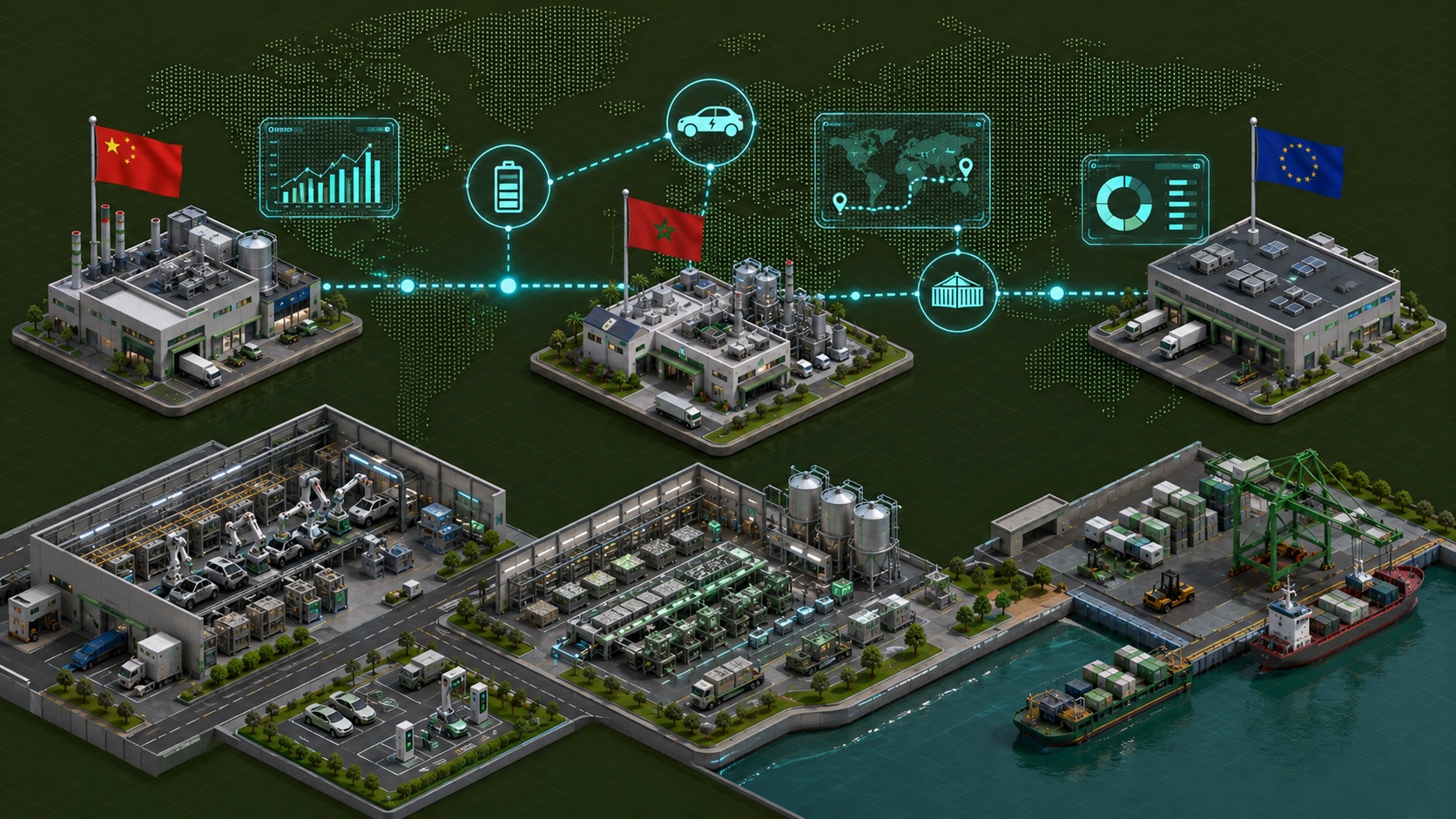
Renault now builds more cars in Morocco than in Spain, 93% of Moroccan textile exports go to the EU, and since 2025 Chinese battery groups have committed several billion dollars to a battery supply chain in Kenitra built explicitly to serve Europe. Morocco has become both a mature nearshoring base and a structured route for Chinese industrial capital into the EU — which makes “Made in Morocco” a due-diligence question as much as a sourcing opportunity.
Morocco has spent the last decade quietly building one of the most complete near-Europe manufacturing ecosystems anywhere in the world: automotive, textiles, and now electric vehicle batteries. What makes Morocco particularly relevant today is not just its proximity to Europe, but the fact that Chinese industrial capital is increasingly choosing Morocco as the platform from which to reach the European market. For European buyers already weighing China, Vietnam, or Eastern Europe as sourcing options, Morocco has quietly become a fourth path worth understanding — and in some cases, one where Chinese and European supply chains now overlap.
Automotive: From Assembly Base to Renault’s Second-Largest Hub Worldwide
Morocco’s automotive industry did not appear overnight. It traces back to 1959, when the government established SOMACA with technical support from Fiat and its French subsidiary SIMCA. Renault has operated in the country for close to a century and became the first international automaker to establish a real production presence there.
The scale reached today is significant. Renault’s plants in Tangier and Casablanca assembled roughly 394,000 vehicles in 2025 — more than the group produced in Spain that year — making Morocco Renault’s second-largest manufacturing base worldwide, after France itself. The Tangier plant alone employs 6,000 people and is the largest automobile factory on the African continent, feeding a supply chain of 87 Tier 1 suppliers, many of them clustered inside the Tanger Med free trade zone just kilometres from the assembly lines. Renault and Dacia together hold 38% of Morocco’s own car market, and Morocco now ranks as Renault’s eighth-largest market worldwide by sales volume.
Stellantis has followed a similar trajectory at its Kenitra plant, part of the Atlantic Free Zone — an area that was empty desert roughly a decade ago and now hosts three dozen factories employing over 20,000 people. Stellantis is investing in engine production capacity there, targeting 350,000 powertrains including hybrid variants, and is reportedly planning to build an electric version of its Grande Panda model in Morocco.
Two structural factors explain why this keeps accelerating rather than plateauing. The Tanger Med port, sitting just a few kilometres from the Tangier plant and under 9 miles from Spain across the strait, processed 161 million tonnes of cargo and more than 11.1 million containers in 2025, giving Morocco genuine port-to-factory logistics that few nearshoring destinations can match. And EU carbon and trade policy is actively reinforcing the shift: industry analysis frames Morocco not just as a market but as a strategic hub that helps automakers cut freight emissions and sidestep carbon-border adjustment costs, directly linking Morocco’s growth to the same EU regulatory pressure (CBAM) already reshaping sourcing decisions in other industrial sectors.
Market forecasts project Morocco’s automotive sector expanding from roughly $4.76 billion in 2026 to $8.44 billion by 2031 — close to 80% growth in five years — driven largely by continued Stellantis and Renault expansion. These sector-value projections come from market research firms (Mordor Intelligence) rather than official government statistics, and should be treated as directional estimates rather than confirmed figures.
Textiles: The Default Nearshore Answer for European Fast Fashion
Morocco’s textile and apparel sector is a cornerstone of the national economy. It employs around 246,000 people (some sources cite closer to 189,000 to 200,000 depending on the scope measured) and generates roughly $7.4 billion in annual revenue. Critically, 93% of Morocco’s textile exports go to the European Union. This is not a diversified export sector; it exists largely to serve Europe.
The country runs four main production clusters: Casablanca (roughly 55% of national apparel output), Tangier (30%), Rabat-Salé (10%), and Fez (5%). Its core advantage is speed rather than the lowest possible cost. Proximity — 14 kilometres from Spain at the closest point — allows seven-day transit times and duty-free access into the EU under existing trade agreements, which matters enormously for fast-fashion buyers who need to react to trends quickly rather than plan production months in advance. Inditex is the clearest anchor tenant of this model, sourcing from over 100 Moroccan suppliers and routing a meaningful share of Zara’s global production through the Tangier and Casablanca clusters.
That said, the sector is not without strain. Morocco’s textile and leather exports fell 9.1% by the end of May 2026 compared to the prior year, with knitwear down 11.8% — a sign that speed and proximity alone are not guaranteeing growth, and that labour availability during peak demand periods, alongside quality and traceability standards, is becoming the real differentiator going forward. Hugo Boss, for instance, has signalled interest in expanding Moroccan sourcing specifically conditional on quality and traceability standards being met.
The Angle That Matters Most: China Is Using Morocco as a Gateway to Europe
This is the development that changes Morocco from another nearshoring option into something directly relevant to any conversation about Chinese suppliers and European buyers.
Since 2025, a cluster of major Chinese battery and battery-materials companies has committed several billion dollars to building an electric-vehicle battery supply chain in Morocco, centred on Kenitra.
Gotion High-Tech is building Africa’s first EV battery gigafactory in Kenitra, with initial investment reported around $1.3 billion, scaling toward a total investment figure cited variously between $5.6 billion and $6.8 billion depending on the source, and a long-term capacity target of 100 GWh (an initial 20 GWh phase was expected to begin production in Q3 2026). Reporting indicates roughly 85% of this output is destined for the European Union.
COBCO, a joint venture between Moroccan investment fund Al Mada and Chinese battery-materials producer CNGR Advanced Materials, has already begun production of precursor cathode active materials (NMC) at a $2 billion plant — the first company in Africa to produce this material — and has secured a supply agreement with Belgian-French group Umicore, explicitly targeting Europe’s battery industry.
BTR New Material Group is investing a further $363.5 million in a second Moroccan plant for anode and cathode materials inside the Mohammed VI Tangier Tech City, a Chinese-Moroccan industrial park originally launched with China’s Haite Group. Other Chinese materials producers reported to be investing in the same Kenitra cluster include Tinci Materials (electrolyte) and Yahua Group (lithium refining). Industry commentary describes this as a deliberate “chain effect,” building a full battery materials supply chain — from raw materials to finished cells — inside one Moroccan industrial zone.
The strategic logic being reported is explicit and worth stating plainly. Morocco’s free trade agreements with both the EU and the US let Chinese manufacturers reach Western markets while sidestepping tariff barriers that increasingly apply to goods shipped directly from China, including US tariffs on Chinese EVs and vehicle parts, and EU scrutiny of Chinese-origin battery and EV supply chains. Morocco’s phosphate reserves — a feedstock for lithium-iron-phosphate battery chemistry — its political stability, and the same Tanger Med logistics infrastructure serving the automotive sector all reinforce the choice.
Why this matters for a European buyer, and not just as a curiosity: a growing share of what looks like “Moroccan-made” battery and EV supply chain output is, in substance, Chinese manufacturing capital and technology operating from a Moroccan address. For a European company evaluating a Moroccan supplier in this space, understanding the actual ownership, technology source, and materials provenance behind a “Made in Morocco” label is now a genuine due-diligence question — not unlike the transshipment and origin questions already surfacing for Vietnam.
Reported investment figures for these projects vary meaningfully across sources, from $1.3 billion (initial phase) to $6.8 billion (full planned scale) for Gotion alone, reflecting the difference between initial agreements and long-term phased targets. These should be verified against the companies’ own disclosures or Moroccan government announcements before being cited as fixed figures in client material.
What This Means for European Buyers
Morocco’s pitch to a European manufacturer combines four things that are hard to find together elsewhere: EU proximity (7-day transit, low freight emissions, no CBAM exposure), existing free-trade access, a genuinely mature automotive supplier base, and — increasingly — access to Chinese battery and materials technology without the direct China-origin complications that now attach to goods, subsidies scrutiny, or tariffs on products shipped straight from China.
That combination creates two distinct opportunities worth separating clearly.
Direct Moroccan sourcing (automotive components, textiles and apparel) is a straightforward nearshoring case, comparable in logic to established nearshoring hubs in Poland, Romania, Bulgaria, and Turkey, but with EU-proximity advantages few Eastern European hubs can match on transit time.
Morocco as a structured entry point for Chinese-origin technology (batteries, EV materials, and likely other sectors following the same chain-effect model over time) is a more complex sourcing conversation. It requires the same origin, ownership, and compliance diligence already being applied to transshipment questions elsewhere, adapted to a new geography.
A Practical Approach for European Buyers Evaluating Morocco
For a European company assessing Morocco for the first time — whether for direct sourcing or as a route into Chinese-backed battery and materials supply — a structured entry point reduces both commercial and reputational risk.
Separate the two Morocco stories in any sourcing brief. Treat automotive and textile sourcing as a mature nearshoring decision, and treat battery and EV materials sourcing as a distinct diligence exercise centred on ownership and origin, not proximity.
Ask who actually owns and operates the plant, not just where it is located. A “Made in Morocco” label on a battery component may sit on top of Chinese capital, Chinese technology, and Chinese management, which changes the compliance and due-diligence questions a buyer needs to ask, particularly around EU scrutiny of Chinese-origin battery supply chains.
Verify quality and traceability standards directly, especially in textiles. The 2026 export decline in Morocco’s textile sector suggests that proximity alone is no longer sufficient to win business; buyers should confirm a supplier’s actual quality systems rather than assuming the sector’s overall reputation applies uniformly.
Track EU carbon and trade policy exposure as part of the sourcing case, not as an afterthought. Morocco’s CBAM-related advantages are a genuine part of its value proposition, but they depend on EU regulatory positions that continue to evolve.
Treat investment figures for Chinese-backed Moroccan projects as directional until confirmed. Given how widely reported figures vary for the same project, cross-check any number used in an internal business case against company disclosures or Moroccan government sources.
The Honest Caveats
A balanced assessment needs to include what remains uncertain.
Automotive and textile sector figures come from a mix of industry associations, market research firms, and government-adjacent sources, with some meaningful variation between them — for example the range cited for Morocco’s textile-sector employment. These should be treated as reasonable estimates rather than precise, audited statistics.
Investment totals for the Chinese-backed battery cluster vary significantly by source and by project phase. The wide range cited for Gotion’s total investment illustrates this well: initial-phase figures and long-term phased targets are often conflated in secondary reporting, and only company or government disclosures should be treated as authoritative.
The pace and final scale of the “chain effect” battery cluster is not yet fully proven. Several of the projects described above are still in early production phases as of mid-2026, and timelines for reaching stated capacity targets should be expected to shift.
The Takeaway
Morocco is not simply the next item on a list of nearshoring destinations. It is becoming a structural bridge between Chinese industrial capital and the European market, layered on top of an already mature automotive and textile export base built specifically to serve EU buyers. This argues for treating Morocco as a genuine addition to European sourcing strategy, and for approaching it with guidance that addresses both faces of the opportunity: sourcing directly from Morocco’s own industrial base, and understanding what “Moroccan-made” increasingly means when the capital and technology behind it originates in China.
Tags
Sources
Morocco World News (Renault/Stellantis production data, 2026); Automotive Manufacturing Solutions (Stellantis Kenitra); Yabiladi.com (Morocco automotive industry history); Mordor Intelligence via Morocco World News (automotive sector forecast); IFC (Morocco textile circularity report, July 2026); MIM Show / mim.org.ma and OneAIM Apparel (Morocco textile nearshoring); Kohan Textile Journal (AMITH/Hugo Boss); Global Textile Times (2026 export decline); Weetracker, Mobility Rising, Electrification Solutions, The International Trade Council, EV24.africa, and S&P Global AutoTechInsight (Gotion, COBCO, BTR Chinese battery investments in Morocco, 2025–2026). Given the pace of change in both the EU-China trade relationship and Morocco’s industrial investment pipeline, all figures — especially investment totals and production timelines — should be re-verified against primary sources or company disclosures before publication.