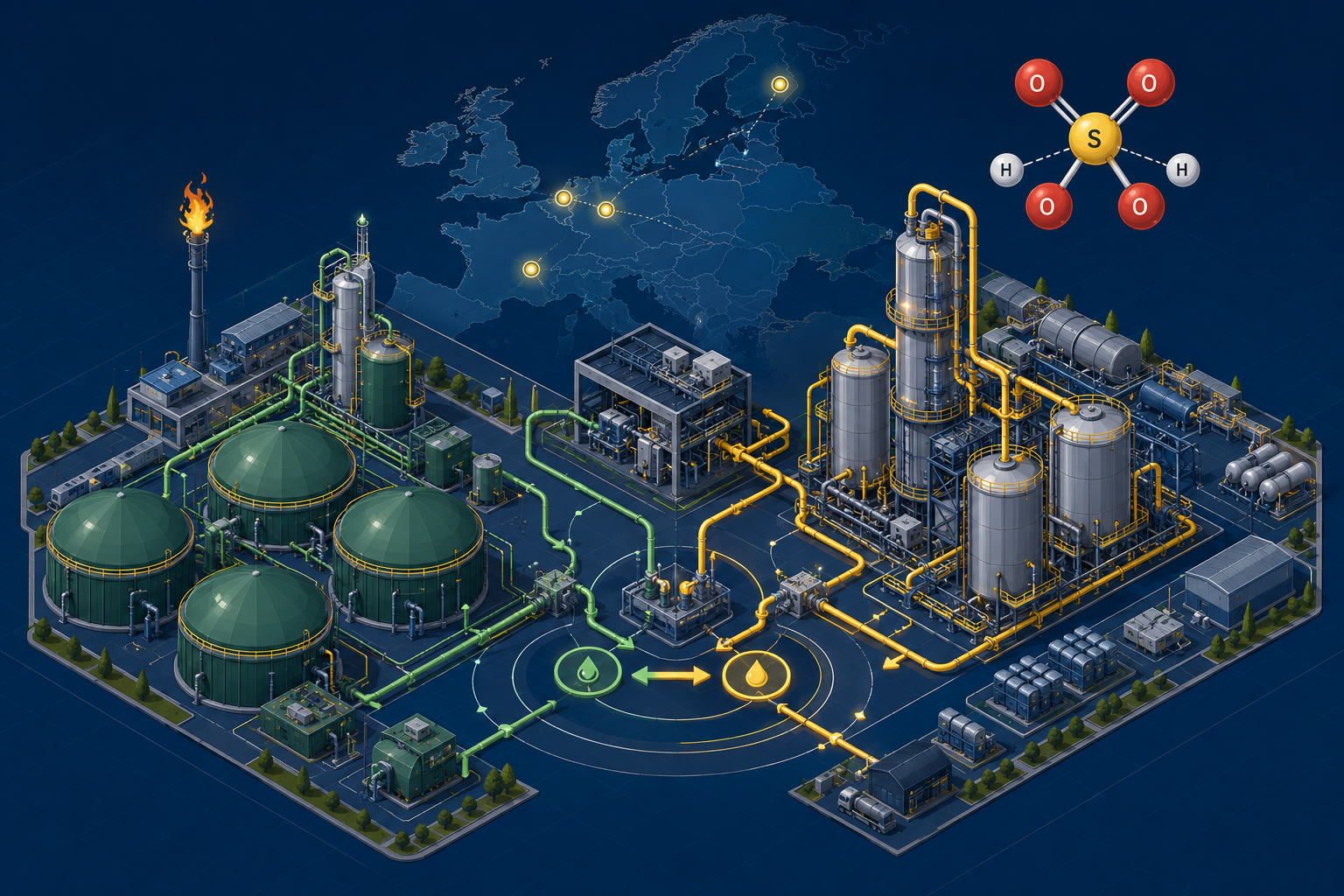
Europe’s most ambitious renewable energy programme — the REPowerEU target of 35 billion cubic metres of biomethane by 2030 — quietly depends on concentrated sulfuric acid. We explain the chemistry that connects manure to clean gas to fertiliser, why the resulting acid demand is uniquely price-inelastic, and what the 2026 sulfuric acid supply crisis reveals about the industrial interdependencies hidden inside the energy transition.
When the European Commission published its REPowerEU plan in May 2022, the language was geopolitical — an emergency response to the energy dependency that Russia’s invasion of Ukraine had suddenly made unsustainable. One of the plan’s most ambitious components was a target to produce 35 billion cubic metres of biomethane annually by 2030, more than doubling the continent’s then-existing renewable gas capacity. The headlines focused on the agricultural substrates, the gas grid connections, the investment mobilisation. Almost no one focused on the chemistry.
Buried inside the most scalable and economically compelling version of European biomethane production — the processing of animal manure through anaerobic digestion — is a chemical dependency that has become, in the crisis year of 2026, one of the sector’s most acute operational vulnerabilities: a structural and growing requirement for concentrated sulfuric acid.
This article explains why.
Part I — The Biomethane Expansion and Its Agricultural Core
Twenty-five years of European biogas. The European biogas industry did not begin with REPowerEU. Its roots are in Germany, where the Erneuerbare-Energien-Gesetz (EEG), first enacted in 2000, created premium feed-in tariffs for electricity generated from biogas. By the mid-2000s, Germany was building approximately 1,000 biogas plants per year. By 2024, the country had over 9,300 biogas plants generating electricity and over 400 plants upgrading biogas to biomethane for direct injection into the gas grid.
The German model diffused progressively across the continent. France moved aggressively into biomethane from around 2018, supported by injection tariff structures; by the end of 2024, France had over 800 biomethane plants and had overtaken Germany in new capacity additions. Italy, Denmark, the Netherlands, and more recently Poland, Spain, and Belgium have all developed substantial biomethane sectors at different levels of maturity.
The European Biogas Association’s 2025 Statistical Report — the most comprehensive annual survey of the sector — recorded 1,620 biomethane-producing facilities at the end of 2024, producing 5.2 billion cubic metres of biomethane across Europe. Total biogas production (including electricity-generating plants) reached 22 billion cubic metres, equivalent to approximately 6% of European Union natural gas consumption. €28.4 billion of private investment had been committed toward new capacity ahead of 2030. These are substantial numbers. They are also approximately one-seventh of where the sector needs to be to meet the REPowerEU target.
The 35 bcm gap. The 35 billion cubic metre target for 2030 requires building approximately 5,000 additional biomethane plants across Europe and mobilising €70–80 billion in investment over six years. The current trajectory, at 5.2 bcm of actual production, implies a scale-up factor of roughly 6.7 from the 2024 baseline. No one in the European energy community seriously expects the target to be met on time; the more defensible question is by how much it is missed and how quickly the gap can subsequently be closed.
What matters industrially is the direction of travel, not the precision of the target. Europe is building biomethane capacity at a rate that will continue regardless of whether the 2030 milestone is hit, driven by the combination of policy frameworks — the Renewable Energy Directive III, the Fit for 55 package, national injection mandates and purchase obligations — and the commercial logic of a sector that can generate revenues from gas sales, from carbon certificates, and increasingly from a by-product that most casual observers of the energy transition have entirely overlooked: nitrogen fertiliser recovered from agricultural digestate.
Part II — The Chemistry That Connects Manure to Clean Gas to Fertiliser
Why ammonia is the problem nobody talks about. Animal manure — the feedstock of choice for the most economically productive European biomethane plants, particularly in Denmark, the Netherlands, northern Germany, northern Italy, Brittany, and the Spanish pig-farming regions — contains concentrations of ammoniacal nitrogen between 3 and 8 kilograms per cubic metre. This nitrogen is chemically present partly as ammonium ion (NH₄⁺) and partly as free ammonia (NH₃), with the equilibrium between the two forms depending on pH and temperature.
In an anaerobic digester operating at the 37–42°C temperatures that optimise microbial activity, this ammonia creates a serious production problem. Above a threshold of approximately 3,000 milligrams per litre of total ammoniacal nitrogen, free ammonia becomes directly toxic to the methanogenic archaea — the microorganisms responsible for the final, methane-producing stage of anaerobic digestion. At these concentrations, biogas yields decline by 20–50% relative to the theoretical maximum. Managing ammonia concentration is therefore not an environmental nicety — it is a core production engineering challenge with direct impact on plant economics.
The conventional response has been process dilution — adding water to reduce nitrogen concentrations — which reduces yields per unit of substrate and creates large volumes of low-concentration digestate that is expensive to store and apply to agricultural land. A more elegant and commercially superior solution is ammonia stripping.
Ammonia stripping: the process and its chemical requirement. Ammonia stripping is a gas-liquid mass transfer process. The liquid fraction of digestate, which typically has a naturally alkaline pH of around 8 from the digestion process itself, is subjected to airflow (or sometimes steam or recycled biogas) at elevated temperature — typically 40–80°C — which drives the equilibrium toward free ammonia gas and strips it out of the liquid phase into the gas stream.
The ammonia-laden gas stream is then passed through an acid scrubber — a column through which a concentrated acid solution flows in countercurrent. When the absorbent acid is concentrated sulfuric acid (H₂SO₄ at 96–98% concentration), the reaction is straightforward and thermodynamically favourable:
2 NH₃ + H₂SO₄ → (NH₄)₂SO₄
The product is ammonium sulfate: a nitrogen-containing salt that is one of the oldest and most established nitrogen fertilisers in agricultural use, with an analysis of approximately 21% nitrogen and 24% sulfur. The stoichiometry of the reaction is fixed: one kilogram of sulfuric acid captures 0.347 kilograms of ammonia and produces 1.347 kilograms of ammonium sulfate.
The result of this process is triple-beneficial for the biogas plant operator. The digestate is substantially denitrified — its nitrogen content reduced by 80–92% — which reduces its regulatory classification as an agronomic waste and simplifies its storage and field application. The digester itself, fed with denitrified recirculated liquid, operates at optimal ammonia concentrations, maintaining full methane yields. And the ammonium sulfate produced is a commercial fertiliser product that can be sold to agricultural buyers, generating a revenue stream entirely independent of the gas.
The economics that make acid demand inelastic. The commercial logic of ammonia stripping is not dependent on the price of sulfuric acid in any normal price range. This is the feature of the sector’s demand profile that distinguishes it from most industrial acid consumers.
One tonne of sulfuric acid, at recent European market prices of €175–200 per tonne, generates 1.347 tonnes of ammonium sulfate. At current ammonium sulfate fertiliser market prices of €150–200 per tonne, the revenue from fertiliser sales covers or exceeds the cost of the acid required to produce it. The sulfuric acid effectively pays for itself from the fertiliser product it creates — even before accounting for the benefits of improved digester efficiency and simplified digestate management.
This economic structure makes demand for sulfuric acid from the biogas sector unusually resistant to price increases. Even at €250 per tonne — the price level that biogas operators were paying before the 2026 supply disruption — the economics of ammonia stripping remain strongly positive. The sector will pay for acid because the alternative — losing the fertiliser revenue and degrading digester performance — costs more. This inelasticity has important implications for how supply disruptions in this market propagate differently than in acid-price-sensitive sectors.
Part III — From Niche to Strategic: The Quantification of a Growing Demand
A market that Eurostat does not track. There is no official European statistical series for sulfuric acid consumption by the biogas and biomethane sector. The European Biogas Association’s annual reports do not include chemical input data. National energy statistics capture biogas production volumes but not the input chemical streams that the more sophisticated plants require. The market exists and is growing rapidly, but it exists in the gap between the energy statistics that track it as a gas producer and the chemical statistics that would need to track it as an acid consumer.
Estimation requires bridging those gaps. The starting point is the number of biomethane plants using ammonia stripping technology — a technique that was relatively rare before 2018 and has become progressively normalised as a standard design feature of new plants processing manure-rich substrates. Industry practitioners estimate that approximately 15–20% of European biomethane plants currently incorporate ammonia stripping, with the rate rising steeply in new plants built since 2023.
At an average consumption of 800–1,000 tonnes of sulfuric acid per plant per year — a figure consistent with medium-to-large plants processing 80,000–200,000 cubic metres of digestate annually — the current installed base generates a demand in the range of 200,000–300,000 tonnes per year. That demand is projected to approach 500,000 tonnes annually by 2027 and could reach 1 million tonnes or more by 2030 if the REPowerEU investment trajectory delivers the planned capacity addition and ammonia stripping technology continues its penetration into new plant designs.
For context: total European sulfuric acid production is approximately 15 million tonnes per year. The biogas sector’s current demand of 200,000–300,000 tonnes represents less than 2% of that total. But the growth trajectory is steep, the demand is geographically dispersed across agricultural regions rather than concentrated at existing industrial sites, and the quality requirements — particularly for heavy metal contamination — are stringent in a way that not all acid sources can easily satisfy.
The Fertiliser Regulation and why acid purity matters. The ammonium sulfate produced by ammonia stripping is not used in an industrial context where metal contamination is manageable. It is applied to agricultural land where it enters the soil, is taken up by crops, and enters the food chain. The European Union Fertilising Products Regulation (2019/1009), which became fully applicable in July 2022, establishes strict limits on heavy metal content in CE-marked fertilisers.
For ammonium sulfate produced from digestate nitrogen recovery — which falls under Component Material Category 15 of the Regulation as a "recovered high-purity material" — the product must achieve 95% or greater dry matter purity and must meet limits including cadmium below 1.5 mg/kg dry matter, mercury below 1 mg/kg, and lead below 120 mg/kg.
These limits translate directly into quality specifications for the sulfuric acid used in the scrubbing process. Contaminants present in the acid — particularly cadmium, mercury, arsenic, and lead — transfer into the ammonium sulfate product. Acid produced through certain industrial processes may carry metal impurity levels that are acceptable for industrial applications but incompatible with fertiliser use. Biogas plant operators sourcing acid for ammonia stripping must therefore specify and verify the heavy metal profile of the acid they purchase, not merely its concentration.
This quality requirement creates a meaningful segment distinction within the sulfuric acid supply market — between acid that can be used for fertiliser-grade applications and acid that cannot — and it is a distinction that is not always well understood by procurement teams unfamiliar with the agricultural endpoint of the downstream product.
Part IV — The 2026 Supply Crisis: A Stress Test of Industrial Interdependencies
Four simultaneous shocks. The global sulfuric acid supply crisis that materialised in late 2025 and intensified through the first half of 2026 has no recent precedent in its combination of causal factors. Four independent supply disruptions converged simultaneously to produce a market dislocation that S&P Global described, in May 2026, as "the worst since 2008."
The first shock was the effective closure of the Strait of Hormuz to commercial shipping, beginning in February 2026, as a consequence of the Iran conflict escalation. The Middle East accounts for approximately 45–50% of global seaborne sulfur exports. Sulfur is the primary feedstock for the dominant route of industrial sulfuric acid production — the combustion of elemental sulfur in a contact process to produce the concentrated acid. With Middle Eastern sulfur inaccessible to European and Asian markets, producers operating on this route faced feedstock shortages and cost escalation simultaneously. Spot sulfur prices rose from approximately $650 per metric tonne in early 2026 to over $1,060 per metric tonne by early May — a 63% increase in ten weeks.
The second shock was a Russian sulfur export ban, in force since November 2025 and extended through June 2026, which removed a secondary source of elemental sulfur that European producers had used as a partial substitute for Middle Eastern supply. The third shock was a Turkish sulfur export restriction introduced in April 2026, eliminating a further marginal supply source.
The fourth and, for European markets, most immediately consequential shock was China’s implementation of a sulfuric acid export ban, effective May 1, 2026. China had been the world’s largest sulfuric acid exporter, shipping approximately 4.6 million metric tonnes in 2025 — a volume representing a significant share of global merchant acid trade. With the export ban in force, this supply disappeared from international markets. European spot prices for sulfuric acid reached $198 per metric tonne in May 2026, against a benchmark of approximately $125 per metric tonne twelve months earlier — a 58% increase — with the trajectory still pointing upward.
The structural divide: smelter by-product vs. sulfur combustion. The 2026 crisis has illuminated a structural divide within the sulfuric acid supply sector that is important for industrial buyers to understand.
Approximately 40% of global sulfuric acid is produced not from elemental sulfur but as a mandatory by-product of non-ferrous metal smelting — primarily copper, zinc, and nickel smelting. When copper sulphide ores are roasted and smelted, sulfur dioxide is released as an unavoidable co-product of the metallurgical reaction. Environmental regulations require that this SO₂ be captured and converted rather than emitted to atmosphere; the standard technology converts it catalytically to sulfur trioxide and then absorbs it to produce concentrated sulfuric acid. A copper smelter producing one tonne of refined copper generates three to four tonnes of sulfuric acid as a structural by-product of its primary production process.
This metallurgical acid has a completely different cost and supply profile from acid produced by elemental sulfur combustion. The smelter’s acid production costs are essentially the processing costs of capturing and conditioning the SO₂ gas stream; there is no feedstock cost for the sulfur itself, because the sulfur is a constituent of the ore that is being smelted for its copper content. The smelter’s acid production is therefore structurally insensitive to elemental sulfur prices, to Middle Eastern export bans, and to any of the supply disruptions that have devastated sulfur-combustion-based producers in 2026.
For buyers of sulfuric acid who need supply continuity through the current crisis, the origin of the acid — smelter by-product versus sulfur combustion — has become the most important supply chain question they can ask. It is a question that many European industrial buyers have not previously found it necessary to ask, because in normal market conditions, both production routes supply into the European market at broadly competitive prices and the origin distinction is commercially immaterial. In 2026, it is the difference between supply availability and shortage.
Part V — The European Policy Framework That Is Accelerating Demand
REPowerEU and its biomethane investment architecture. The regulatory architecture supporting European biomethane expansion is multi-layered and mutually reinforcing in ways that collectively guarantee continued sector growth regardless of short-term market volatility.
REPowerEU’s 35 billion cubic metre biomethane target is supported by the Biomethane Industrial Partnership — a coordinated Commission-industry mechanism for tracking and accelerating the investment pipeline — and by the national support schemes that translate European targets into investible cash flows. Italy has committed €2.2 billion to a new biomethane financing instrument. Spain has allocated €4.8 billion from NextGenerationEU and its national climate plan. Denmark has committed €3.1 billion in subsidies through 2030. France’s biomethane injection mandate, which entered force in 2026, creates a compulsory demand pull for biomethane in the national gas network.
Poland, which injected its first biomethane into the national grid in 2025, has established a state support programme and has attracted major international energy group investment into large-scale biogas facilities. Poland’s agricultural substrate base — extensive livestock production generating large volumes of manure — positions it as one of the highest-potential biomethane markets in Europe for the coming decade.
The Nitrates Directive and RENURE: a regulatory accelerant. The EU Nitrates Directive (91/676/EEC), originally enacted in 1991, establishes limits on nitrogen application from agricultural manures in Nitrate Vulnerable Zones — areas where groundwater nitrate concentrations are elevated or at risk. The standard limit is 170 kilograms of nitrogen per hectare per year from organic sources.
In September 2025, the European Union’s Nitrates Committee endorsed a proposal (subsequently incorporated into Directive 2026/288) that allows an additional 80 kilograms of nitrogen per hectare per year from a new category of products called RENURE — Recovered Nitrogen from manURE. RENURE products are nitrogen-rich materials derived from the processing of animal manure that have been treated sufficiently to reduce their ammonia emissions potential and their pathogen load to levels comparable with synthetic nitrogen fertilisers.
Ammonium sulfate produced by ammonia stripping of digestate is a candidate RENURE product. If it qualifies — and the European Commission’s Joint Research Centre has assessed that the nitrogen leaching characteristics of such products are equivalent to synthetic nitrogen — it can be applied at rates up to 250 kilograms of nitrogen per hectare per year rather than the standard 170 kilogram limit. This effectively increases the agricultural land area on which the fertiliser product can be used at economically meaningful rates, expanding the market and improving the economics of the ammonia stripping investment.
The RENURE development simultaneously creates a regulatory imperative for ammonia stripping and a regulatory reward for it: operators who install the technology can market their ammonium sulfate product under the RENURE designation, access expanded application rates, and position the product as a high-quality, regulated alternative to synthetic fertilisers in agricultural supply chains that are increasingly scrutinised for their nitrogen management practices.
The soil sulfur deficit: a quietly expanding market. A third regulatory and agronomic driver of ammonium sulfate demand is less widely discussed but structurally durable. European soils are becoming sulfur-deficient.
The mechanism is counterintuitive but well-documented. The dramatic reduction in sulfur dioxide emissions from European industry and power generation since the 1980s — driven by acid rain regulation — has removed a significant source of atmospheric sulfur deposition that European agricultural soils had historically relied upon. Crops that require sulfur — oilseed rape, cereals, onions, brassicas — are increasingly showing sulfur deficiency symptoms in regions where atmospheric deposition was previously sufficient. Agronomic advice across northwestern Europe now routinely recommends sulfur-containing fertiliser applications where none were necessary thirty years ago.
Ammonium sulfate, with its 24% sulfur content alongside 21% nitrogen, is a precisely suited answer to this agronomic challenge. Its adoption by European farmers is driven not by regulation but by agronomic necessity, and its market has been growing consistently irrespective of biogas policy. The ammonium sulfate produced by biogas plant ammonia stripping units enters a market that is itself expanding — a structural alignment that reinforces the economics of the technology investment.
Part VI — Country Dynamics: Where the Demand Is Building
The mature markets: Germany, France, Denmark. Germany’s biomethane sector is the largest in Europe by installed capacity but has been operating under regulatory uncertainty for several years, with the EEG reform process creating stop-start investment incentives. New plant construction has slowed relative to the 2018–2022 peak, but the existing installed base — including several hundred plants with ammonia stripping — generates a stable and substantial acid demand that will persist through the current investment pause.
France is now Europe’s most active market for new biomethane plant commissioning, with over 800 operational injection points and a pipeline of over 1,100 projects awaiting grid connection. The French injection mandate of 2026 creates a floor demand for biomethane volumes that will draw investment through the remainder of the decade. The French sector’s feedstock mix — more diversified than Germany’s, including significant volumes of food waste and municipal organic fractions alongside agricultural substrates — means that ammonia stripping adoption rates are somewhat lower than in the purely manure-intensive Danish and German models; but the scale of the French investment pipeline ensures that the absolute volumes are substantial.
Denmark is the most mature biomethane market in Europe in terms of penetration — approximately 40% of Denmark’s gas consumption is met by biomethane, and the country is targeting 100% renewable gas in the national network by 2040. Danish plants are characterised by the largest average scale on the continent (average capacity of nearly 1,500 cubic metres per hour, roughly four times the European average), heavy manure reliance, and sophisticated digestate management including near-universal ammonia treatment. Denmark’s per-plant acid consumption is among the highest in Europe, and the concentrated nature of the sector — large plants served by established supply relationships — creates procurement consolidation opportunities distinct from the fragmented small-plant landscapes in other countries.
The growth markets: Italy and Spain. Italy has undergone a transformation in its biomethane sector that has few parallels elsewhere. From fewer than ten biomethane plants in 2018, Italy has grown to over 130 by 2025, driven by a specific and generous Italian support mechanism (the DM Biometano) that provided premium tariffs for biomethane produced from agricultural substrates — and particularly for biomethane accompanied by ammonium sulfate fertiliser production, which the Italian incentive structure explicitly rewards. The Italian regulatory framework is unique in Europe in creating direct financial incentives for the nitrogen recovery process that generates ammonium sulfate; Italian operators receive higher biomethane support tariffs when they install ammonia stripping, making the decision to adopt the technology not merely commercially attractive but actively incentivised.
This Italian policy design has made the country one of the highest-concentration markets for ammonia stripping in Europe, and by extension one of the most concentrated sources of acid demand growth. The €2.2 billion new Italian biomethane financing instrument announced for 2026 will accelerate this further, with the number of Italian plants projected to grow from approximately 130 to several hundred by the end of the decade.
Spain presents the largest potential growth opportunity on the continent but the least developed current base. With only 15 operational biomethane plants despite a theoretical substrate potential of 163 terawatt-hours per year — the highest in Europe — Spain is the market where the gap between potential and reality is widest. The €4.8 billion in planned investment, supported by NextGenerationEU and the national PNIEC climate plan, is beginning to translate into construction starts. Spain’s dominant agricultural substrate is swine manure, from the pig production that makes Catalonia and Aragón among the most intensive livestock regions in the European Union — a feedstock profile with very high nitrogen concentrations that makes ammonia stripping not optional but agronomically necessary.
Conclusion: An Overlooked Link in the Green Energy Chain
The European biomethane sector is a well-understood industrial success story in terms of its gas production metrics, its policy support, and its role in the energy transition. It is less well understood as an industrial chemical consumer. The sulfuric acid requirement embedded in the most productive version of European biomethane production — the manure-fed plants that dominate in Northern and Central Europe and are the growth segment in Southern Europe — is structural, growing at compound rates consistent with the sector’s investment pipeline, and resistant to price elasticity because the acid pays for itself from the fertiliser it produces.
The supply crisis of 2026 has served as a stress test that revealed the sector’s exposure to a commodity supply chain most of its operators had not previously needed to think about strategically. The distinction between sulfuric acid produced from elemental sulfur combustion — structurally exposed to the Middle Eastern feedstock disruptions and Chinese export restrictions that drove 2026’s price and availability crisis — and acid produced as a metallurgical by-product of copper and zinc smelting, which is structurally immune to these same disruptions, has become a supply chain differentiation that European biogas operators and their procurement managers will need to incorporate into long-term supply strategies.
As Europe builds out toward the 35 billion cubic metre target, and as ammonia stripping technology penetrates from its current 15–20% share of plants toward the 35–40% adoption that the regulatory and economic drivers suggest by 2030, the sulfuric acid demand profile of this sector will transition from a niche commodity market to a material input with strategic supply chain implications. The operators and intermediaries who understand this dynamic ahead of the market will be better positioned to manage cost, continuity, and quality — the three dimensions that determine whether ammonia stripping remains the value-creating process it is designed to be.
Tags
Sources
European Biogas Association — 15th Statistical Report (December 2025); European Biogas Association — Biomethane Investment Outlook 2025; IEA — Renewables 2025: Biomethane chapter; S&P Global Commodity Insights — Global sulphur and sulphuric acid market analysis (May 2026); Stellarix — Global Sulfur Supply Crisis report (April 2026); European Commission — REPowerEU Plan (May 2022); European Parliament — Regulation (EU) 2019/1009 on fertilising products; European Commission — Nitrates Committee RENURE Directive (2026/288, September 2025); Grand View Research — Global sulfuric acid market analysis; IndexBox — EU sulfuric acid market data 2024; Market Data Forecast — European ammonium sulfate market 2024–2033; USGS — Materials flow of sulfur report; Biorig Energy — Biomethane in Europe country analysis.