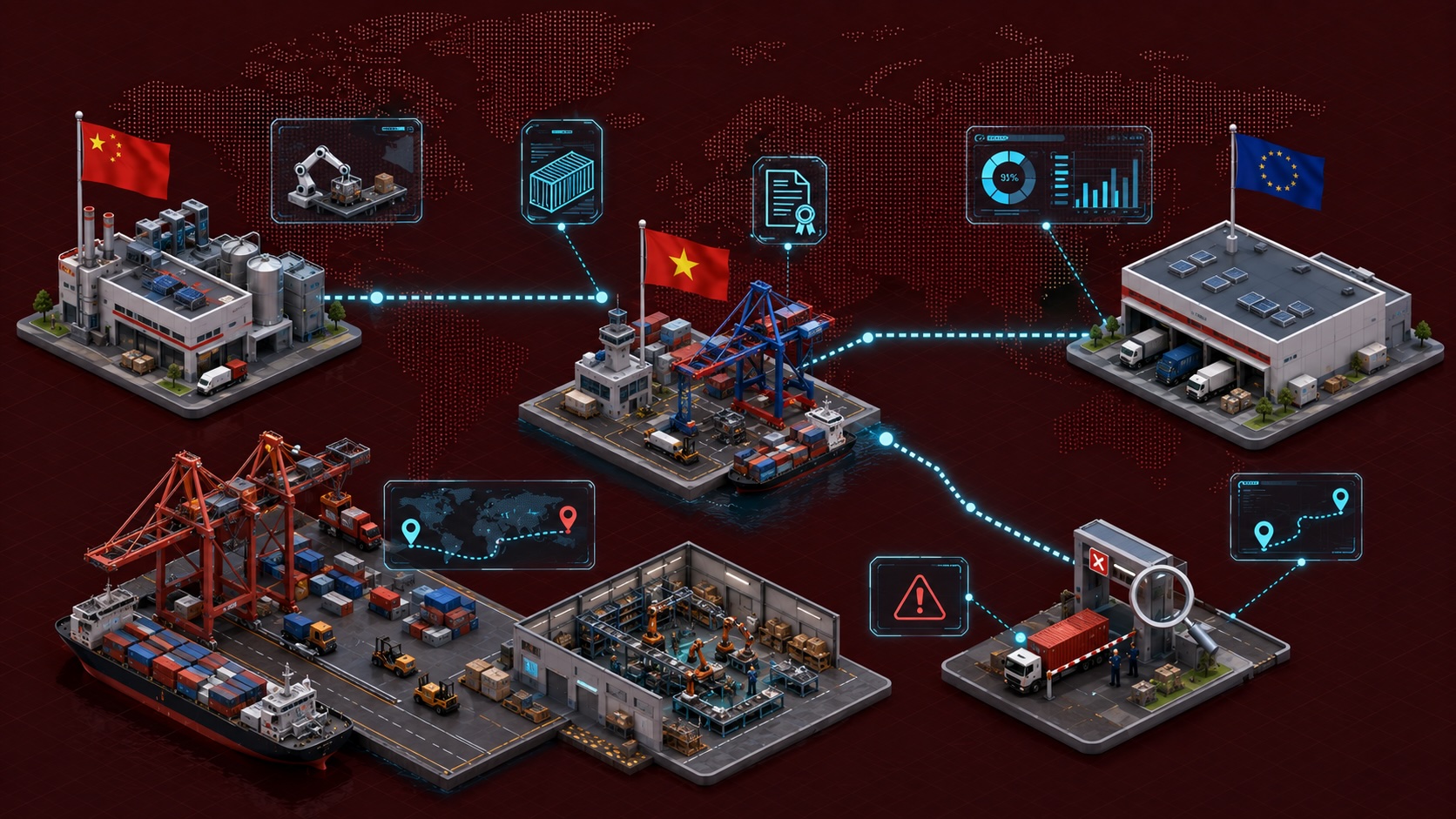
A 40% US transshipment penalty with no mitigation or remission mechanism, a legal basis that has changed twice in six months, an additional 12.5% Section 301 forced-labour tariff from July 2026, and CBP inspectors now walking Chinese-linked factory floors inside Vietnam. European buyers shipping into Europe are not exempt from the fallout — they share supply chains, suppliers, and increasingly the same origin questions. We set out what has actually changed, and what to verify in a supplier file.
Vietnam has been the default answer to “where do we move production if not China” for the better part of a decade. What is changing in 2026 is not Vietnam’s attractiveness. It is the growing gap between what US customs enforcement now demands to prove a product is genuinely Vietnamese, and what many companies — including plenty of European buyers, even though the enforcement regime is American — actually have in their supplier files to prove it.
Why This Is Suddenly Urgent, Not Theoretical
Transshipment risk for Vietnam is not new. It dates back to a July 2025 US-Vietnam trade framework that set a 20% baseline tariff on genuinely Vietnamese goods alongside a 40% penalty on goods deemed transshipped: cargo that is substantially Chinese in origin but routed through Vietnam and relabeled to escape tariffs aimed at China. What has changed through 2026 is the intensity and unpredictability of enforcement.
The legal basis has shifted twice in six months. The original transshipment framework relied on the International Emergency Economic Powers Act (IEEPA). Following the US Supreme Court’s ruling in *Learning Resources, Inc. v. Trump* in February 2026, that authority was replaced by Section 122 of the Trade Act of 1974, which itself carries a roughly six-month sunset, expiring around July 24, 2026. On that same date, USTR’s separate Section 301 forced-labor investigation findings took effect, adding a further layer of tariff exposure.
A new Section 301 forced-labour tariff now applies on top of everything else. On July 24, 2026, USTR imposed an additional 12.5% Section 301 tariff on Vietnamese imports, following a March 2026 investigation that concluded Vietnam had not sufficiently enforced prohibitions on goods made with forced labour. Vietnam was named alongside 59 other economies in this investigation — a reminder that this pressure is not Vietnam-specific, but Vietnam is exposed to it on top of its existing China-adjacent tariff risk.
Enforcement has become physically active, not just a paperwork exercise. Reporting indicates US Customs and Border Protection has begun conducting surprise inspections of Chinese-linked factories inside Vietnam, examining value-added ratios and documentation in person rather than simply flagging shipments after the fact. And the 40% transshipment penalty carries no mitigation or remission provision: unlike ordinary tariff disputes, a shipment classified as transshipped is not eligible for exemption requests or negotiated relief once the determination is made — an unusually harsh enforcement posture by US trade standards.
What “Substantial Transformation” Actually Requires, and Where It Breaks Down
The legal test CBP applies is not new. A product qualifies as originating in Vietnam if it undergoes substantial transformation there, emerging with a new name, character, or use, typically evidenced by a shift in tariff (HTS) classification. Simple assembly or relabeling of Chinese components does not qualify, regardless of where the final box is packed and shipped from.
In practice, enforcement guidance now describes this in blunt terms. A laptop whose motherboard, display panel, battery pack, and chassis all arrive from China and are simply snapped together in Vietnam emerges as the same laptop it was before assembly, not a new article of commerce. Its classification typically remains Chinese-origin for tariff purposes, however the paperwork is filed. Industry sourcing guides now describe a rough exposure threshold: if a supplier sources somewhere in the range of 40 to 60% or more of a product’s inputs from China and performs only assembly in Vietnam, CBP may determine the goods are of Chinese origin and apply full tariffs retroactively.
This matters enormously for the furniture, electronics, and consumer goods categories that moved to Vietnam specifically to escape China tariffs, because the gap between Vietnamese and Chinese duty rates on these categories is large. One 2026 sourcing analysis put furniture tariffs at roughly 35 to 40% from China versus 10 to 15% from Vietnam. That gap is precisely what creates the incentive to transship, and precisely why enforcement is concentrated there.
The specific input-share thresholds cited above (40 to 60%) come from commercial sourcing advisories rather than a published CBP rule, and should be treated as an industry rule of thumb rather than a legal bright line. Actual determinations are made case by case on substantial transformation, not a fixed percentage.
Why This Is a European Problem Too, Even Though the Tariffs Are American
European buyers sourcing from Vietnam are typically shipping into Europe, not the United States, so it would be easy to read all of the above as an American customs issue. Two reasons that reading is incomplete deserve attention.
First, many European buyers share supply chains with US-facing customers. A Vietnamese supplier serving both European and American buyers with the same production line does not necessarily segregate compliant output for the EU and at-risk output for the US. If that supplier gets flagged, raided, or sanctioned by CBP, or has its US access effectively cut off by the 40% penalty, the disruption to capacity, lead times, and the supplier’s financial stability affects every buyer on that line — including European customers.
Second, the underlying question is the same one European authorities are asking. How much of this product is actually Chinese dressed as Vietnamese is exactly the question European customs authorities, EU anti-dumping investigators, and increasingly EU corporate sustainability and supply-chain due-diligence regulation are asking, independent of what the US decides. A supplier whose documentation cannot survive CBP’s substantial-transformation test is unlikely to survive equivalent scrutiny if the EU tightens its own rules of origin or anti-circumvention measures on the same product categories — something the EU has already done in specific sectors (solar panels, e-bikes) in past years.
There is also a geopolitical layer worth flagging plainly. Reporting from July 2026 describes US-Vietnam negotiations over the next tariff phase as tense and very difficult, with the US reportedly pushing Vietnam to align with US export-control policy as a condition of preferential access. If Vietnam’s trade relationship with the US becomes entangled with broader US-China tech and export-control tensions, that instability itself becomes a supply-chain risk for European buyers relying on the same factories, independent of tariff rates.
What European Buyers Should Actually Check
For a European company that shifted sourcing to Vietnam as part of a China+1 strategy — which describes a large share of the current client base working with sourcing consultancies in the region — a few concrete due-diligence steps matter more in 2026 than they did even a year ago.
Ask for the value-added breakdown, not just a country-of-origin certificate. A certificate of Vietnamese origin is not proof against a substantial-transformation challenge. What matters is the actual share of Chinese-origin components and the nature of the manufacturing operations performed in Vietnam.
Understand whether a supplier is being audited for the US market, and what that audit actually covers. A supplier passing routine Vietnamese export documentation is not the same as one that has been tested against CBP’s substantial-transformation standard.
Treat supplier concentration risk seriously. If a Vietnamese supplier’s US-facing business is disrupted by enforcement action, and that supplier represents a meaningful share of a buyer’s own volume, lead times and pricing are exposed even though shipments never touch a US port.
Watch for the same scrutiny arriving from the EU side. The categories most exposed to US transshipment enforcement today — electronics, furniture, and other assembly-heavy goods with high Chinese input content — are reasonable candidates for the EU to examine next, particularly as EU anti-circumvention and supply-chain due-diligence rules continue to develop.
Don’t assume today’s tariff rate is stable. The legal basis for Vietnam’s US tariff treatment has already changed twice in 2026 (IEEPA to Section 122 to Section 301), each time on short notice. Sourcing decisions built around a single point-in-time tariff figure are built on a moving target.
The Honest Caveats
A few elements of this picture need explicit qualification.
The 40 to 60% input-share threshold is an industry guideline, not law. CBP determinations are made case by case against the substantial-transformation standard, and a supplier below this rough threshold is not automatically safe, nor is one above it automatically penalised. Treat it as a planning heuristic, not a compliance guarantee.
Section 122’s sunset and its replacement are not fully settled. The legal basis for Vietnam’s US tariff treatment has changed twice within six months as of mid-2026, and further changes before year-end cannot be ruled out. Any figure or legal citation in this article should be checked against current USTR and CBP publications before being used in client-facing material.
EU-side enforcement of equivalent origin questions has not yet reached the intensity seen on the US side. The parallel drawn here between US and EU scrutiny is a reasonable expectation based on precedent in other sectors, not a description of an EU enforcement action that has already occurred for Vietnam specifically.
The Takeaway
Vietnam remains a legitimate and valuable pillar of a China+1 strategy, and nothing above changes that. What has changed is the margin for error on documentation. The 40% transshipment penalty’s lack of any mitigation or remission mechanism, combined with active physical enforcement and a legal framework that has shifted twice in six months, means the old approach of treating “made in Vietnam” as a settled fact rather than a claim that needs an evidentiary file behind it is no longer a safe assumption — for US-facing shipments today, and quite plausibly for EU-facing shipments before long.
Tags
Sources
Vietnam Briefing (Section 301 forced labour tariff, July 2026); USTR press releases and Federal Register notices (June–July 2026); Congressional Research Service / EveryCRSReport (Section 301 legal authority summary, July 2026); Cosmo Sourcing and Trade With Viet (transshipment enforcement mechanics and Section 122 timeline, April–July 2026); SupplyChainStack and Attahir Labs (input-share exposure guidance, 2026); TechTimes (CBP factory inspections and US-Vietnam negotiation status, July 2026); Harris Sliwoski / China Law Blog and Time (original July 2025 US-Vietnam framework). Given how frequently the legal basis and rates have changed in 2026, all figures and enforcement details should be re-verified against current USTR and CBP publications, or a customs attorney, before being used in client-facing material or sourcing decisions.